Most often read
- •
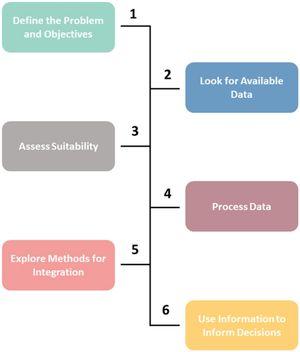
Data collection can deplete conservation resources.
- •
This can be circumvented by making better use of readily available data.
- •
We provide a roadmap for how researchers can make better use of existing data.
- •
Doing so will make conservation research more efficient and effective.

- •
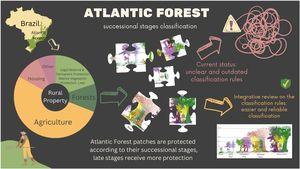
Since 1990, the intense threat faced by the Atlantic Forest pushed the enactment of dedicated laws safeguarding its native vegetation.
- •
Current successional stages’ parameters are subjective and imprecise, hindering environmental permitting and related offset policies.
- •
We highlight the current classification’s main limitations, propose specific improvements, and suggest creating a new inclusive framework.
- •
It is urgent to review, clarify, simplify, and increase the scientific reliability of the classification of successional stages.

- •
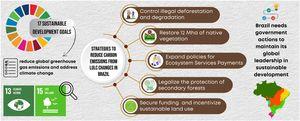
Brazil reached 2.8 Mha of native vegetation removal in 2022, the highest rate since 2008.
- •
15.8 Mha of Legal Reserve areas need restoration in Brazil’s private rural properties, over half in the Amazon.
- •
5.46 Mha of forest regrowth occurred in Brazil from 2016 to 2022, 40% in the Amazon and 36% in the Atlantic Forest biome.
- •
Secondary forests in Brazil lack proper legislation to safeguard their carbon mitigation potential in the long-term.
- •
Incentives to environmental payment, law enforcement, and legal framework needed for Brazil's 78 Mha surplus vegetation.

- •
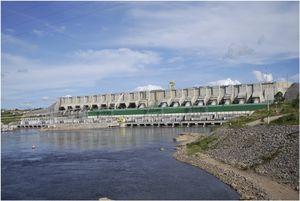
Brazil’s Amazonian hydroelectric dams are a concern regarding Lula’s presidency.
- •
Lula initiated and still defends the Belo Monte Dam, which has catastrophic impacts.
- •
The Volta Grande, a 130-km river stretch, has lost over 80% of its natural flow.
- •
Traditional people, including three indigenous groups, have lost food security.
- •
Renewal of Belo Monte’s operating license tests Lula’s socioenvironmental commitment.

- •
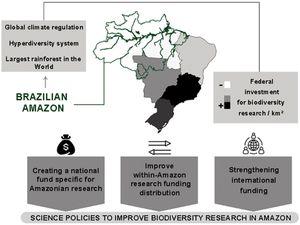
The federal grants and scholarships are uneven distributed between Brazilian regions.
- •
The North region receives the least number of scholarships and grants per km² in Brazil.
- •
The current federal budget is insufficient to cover large-scale research in the Amazon.
- •
New national and international funds need to be created to improve Amazon biodiversity research.

- •
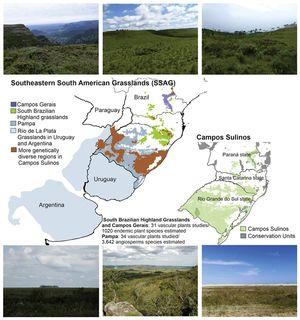
Campos Sulinos are neglected in terms of conservation and biodiversity studies.
- •
We recovered 58 works about population genetics and phylogeography in Campos Sulinos.
- •
High genetic variability and population structure were found in plants from Campos Sulinos.
- •
There is a gap in genetics and genomics data availability in Campos Sulinos to apply in biodiversity conservation.
- •
Genetics and genomics data are critical to address goals for CBD post-2020 Global Biodiversity Framework in Campos Sulinos.

- •
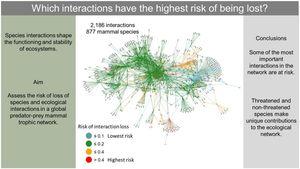
Ecological interactions shape the functioning and stability of ecosystems.
- •
We assessed the vulnerability of species and their interactions in a mammal network.
- •
The most important interactions in the network are, at least, partially at risk.
- •
Threatened and non-threatened species make unique contributions to the ecological network.

- •
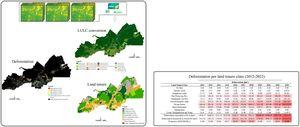
A deforestation hotspot emerges in a region planned for agricultural development in the - Amazon rainforest.
- •
Deforestation grows in all land tenure classes, especially after the project became widespread, in 2018.
- •
Forest loss increased in protected areas after 2018, except in Indigenous Lands, which resist as protective shields.
- •
Contrary to economic development, it can trigger socioeconomic losses and affect essential edaphoclimatic conditions for agricultural activity.
- •
Environmental impact studies need to be concluded before establishing the zone for agricultural development.

- •
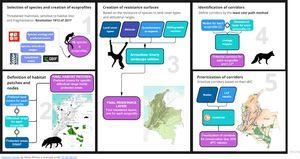
Large forest patches within PAs aid at maintaining the connectivity for small dispersal mammals.
- •
High anthropization in the Andean region limits the connectivity for forest mammals.
- •
Deforestation in the Andes Amazon Transition Belt (AATB) threatens identified priority corridors.

- •
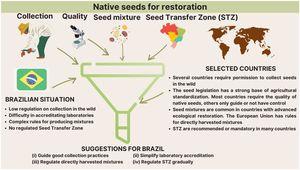
The Brazilian legislation on native seeds has bottlenecks and gaps that can be addressed based on international best practices.
- •
Seed collection from nature should be discussed and standardized by environmental agencies to ensure it becomes a sustainable practice.
- •
Seed quality is crucial for the success of ecological restoration, but it should not adhere to the standardization required for agricultural cultivars.
- •
The commercialization of species mixtures for restoration, including directly harvested ones, should be facilitated to promote biodiversity.
- •
The implementation of seed transfer zones is highly recommended to guarantee the resilience of restored ecosystems in the long term.

- •
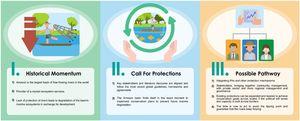
The Amazon basin is approaching a tipping point, and is therefore of paramount concern for biodiversity conservation.
- •
While attention is paid to the protection of terrestrial ecosystems, freshwater efforts lag behind, despite rising threats.
- •
Basin-wide conservation policy development, implementation, and enforcement requires commitments across all scales.
- •
Stakeholder's participation in the system could be facilitated by supporting cross-border and cross-scalar capacity-building.

- •
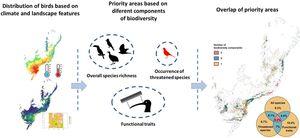
Overlap of priority areas for bird conservation based on three diversity components is low.
- •
The current Protected Areas network does not cover the most important areas.
- •
Climate change can have a low impact on priority areas for conservation.
- •
We show priority areas where the current Protected Areas network could be expanded.

- •
Jaguars revisited forest, drainage, agriculture, and roads edge frequently.
- •
Larger forest patches are vital refuges for jaguars in human landscapes.
- •
Jaguars avoided large agricultural areas but often revisited their edges.
- •
Jaguars moved faster near roads, avoiding prolonged stays in these areas.
- •
Jaguars moved slower near drainage areas, which they frequently revisited.

- •
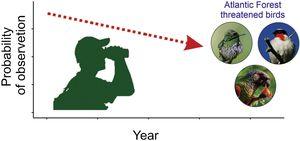
Bird species of the Atlantic Forest in Brazil are threatened and declining.
- •
Declines can lead to decreased detectability and fewer observations.
- •
We analyzed bird data from three citizen science platforms for 2000–2022.
- •
The representation of threatened and Near Threatened species decreased through time.
- •
We recommend future species-specific monitoring to fill survey gaps.

- •
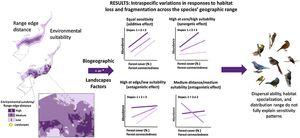
Bird sensitivity varies across distribution ranges and environmental gradients, shaping distinct population patterns.
- •
Four patterns: edge, equal, core, and varying sensitivity to landscape changes.
- •
Dispersal ability, habitat specialization, and distribution range do not fully explain sensitivity patterns.
- •
Species' intraspecific sensitivity variations call for adaptive conservation strategies.

- •
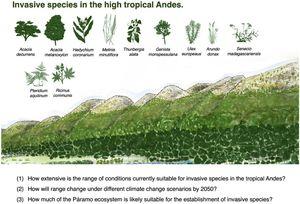
Tropical mountains provide favorable habitats for invasive plant species.
- •
Climate change is expected to open new space for the spread of invasive species.
- •
Invasive species could gain between 1,000 and 10,000 km2 of more suitable areas.
- •
The areas of greatest suitability are not necessarily at the highest elevations.

- •
Claiming to save a biome threating another due to imprecise language is unreasonable.
- •
There is a multisector neglect towards the Cerrado when compared to the Amazon.
- •
“Savannization of the Amazon” refers to forest degradation instead of old-growth savanna.
- •
The term “savannization of the Amazon” can forfeit natural savanna conservation.
- •
The term “savannization of the Amazon” should be abandoned.

- •
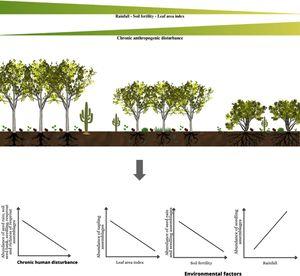
Dry-forest regeneration mechanisms respond to both natural and human drivers.
- •
Caatinga regeneration relies on low-density and taxonomically impoverished regenerating assemblages.
- •
Resprouts rather than seedlings and saplings support Caatinga regeneration.
- •
Chronic human disturbances pose negative effect on regeneration mechanisms such as seed rain and seedling abundance.
- •
Agricultural better practices are required to improve Caatinga resilience.

- •
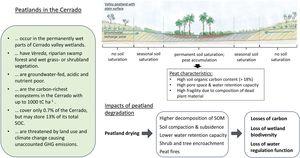
Peatland distribution and extent in the Cerrado is yet underestimated.
- •
Peatlands are part of Cerrado valley wetlands and occur with Veredas, wet grassland and riparian swamp forest vegetation.
- •
Although soil carbon data on peatlands is lacking, they may store 13.3% of the Cerrado soil carbon on only 0.7% of its area.
- •
Hydrological studies are needed to quantify the role of peatlands in the Cerrado.
- •
Intensive agriculture, wood plantations and other land uses threaten Cerrado peatlands and other wetlands.

- •
Coffee crops have higher herpetofauna diversity than other anthropic cover types.
- •
We identified 33 species, including frogs, toads, lizards, and snakes.
- •
Fixed band transects for visual encounter were used to sample herpetofauna.
- •
Microhabitats (leaf litter, humidity, rocks) influenced herpetofauna richness.
- •
Six principles of sustainable management are proposed to coexist with herpetofauna.