- •
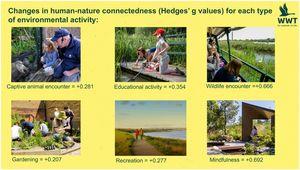
We reviewed changes in human-nature connectedness linked to 6 environmental activities.
- •
Human-nature connectedness increased most after mindfulness and wildlife encounters.
- •
Human-nature connectedness increased most after activities carried out over 2–7 days.
- •
Changes in human-nature connectedness did not vary between adults and children.
- •
Activities facilitated by conservation organisations foster human-nature connectedness.
- •
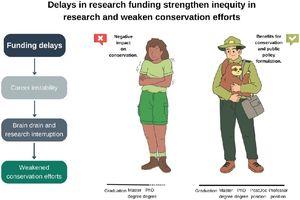
Irregular funding in Brazil fosters ECR brain drain, hindering biodiversity research.
- •
Delays fuel research attrition and deepen inequities in conservation science.
- •
Disrupted research threatens Brazil’s environmental leadership.
- •
Streamlined funding can reduce financial insecurity and attrition among ECRs.
- •
Stable funding strengthens research quality and supports Brazil’s conservation goals.
- •
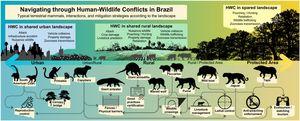
Human-Wildlife Conflicts with iconic mammals in Brazil are highlighted.
- •
Main conflicts are divided between shared and spared landscapes.
- •
Calls for inclusive, community-driven paths to foster coexistence.
- •
Mitigation measures across species and landscapes are presented.
- •
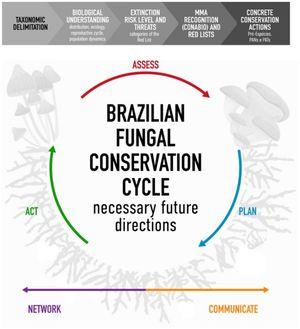
Brazil harbors high fungal diversity, much of it still undocumented.
- •
Fungi have long been overlooked in national biodiversity conservation policies.
- •
Recent policy change enables a turning point for fungal conservation in Brazil.
- •
Inclusion of fungi in public policies is essential for biodiversity goals.
- •
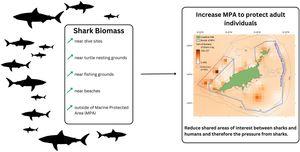
The Fernando de Noronha Archipelago is a shark hotspot.
- •
Humans influence sharks through the competition for prey and joint use of reefs.
- •
Sharks need conservation, especially the largest which were found outside the MPA.
- •
We propose including a bigger part of the home range of resident sharks in the MPA.
- •
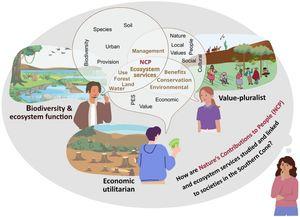
Since 2015, research on ecosystem services and nature’s contributions to people has consolidated in the Southern Cone.
- •
Economic and sociocultural studies are well-established, but ecological perspectives still predominate.
- •
Most studies do not engage social actors or governance frameworks.
- •
Advancing plural valuations requires enhanced bridging, negotiation, social networking, and governance abilities.
- •
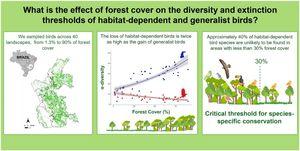
The decrease in forest cover leads to nearly twofold greater loss of forest-dependent birds compared to the gain of habitat-generalists.
- •
Species composition of forest-dependent and habitat-generalist bird assemblages are positively correlated with the variation in forest cover within the landscape.
- •
The required amount of forest cover to protect forest-dependent birds in the Atlantic Forest is higher than 30%.
- •
The benchmark of 20% of forest cover established by Brazilian law may not provide sufficient protection for most forest-dependent bird species.
- •
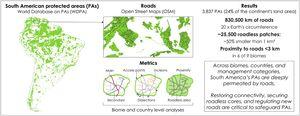
830,000 km of roads (∼20× Earth’s circumference) run through 3,837 protected areas in South America.
- •
83% of protected land is roadless but fragmented into ∼25,500 patches; half <1 km² and only 6% >100 km².
- •
Roads are widespread across regions and IUCN categories; in most biomes, median interior distance to roads is ≤3 km.
- •
Mitigation requires restoring connectivity, roadless cores, road regulation, and biodiversity-sensitive planning.
- •
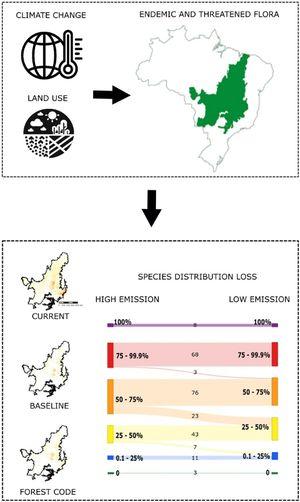
Projections indicate significant species range reductions by 2050, even under optimistic climate scenarios.
- •
The interaction between land-use and climate change leads to compounded impacts on the threaten the endemic Cerrado flora.
- •
Partial implementation of the Forest Code leads higher biodiversity loss in the Cerrado.
- •
Despite Forest Code safeguards, complementary measures are essential to secure Cerrado biodiversity.
- •
Conservation plans must address both climate change impacts and land-use dynamics to preserve the ecological integrity of the Cerrado.
- •
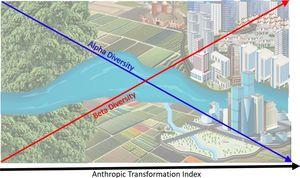
Landscape features play potencial roles in shaping the biodiversity of aquatic microorganisms.
- •
Anthropogenic transformation impacts alpha e beta diversity of the zooplankton.
- •
The conservation of riparian zones in the Atlantic Forest helps to sustain zooplankton biodiversity.
- •
Implementing NbS criteria can be essential to ensure its full potential.
- •
Studies are still focused on NbS biophysical dimension.
- •
Increased complexity in NbS projects can reduce effect size but increase its variability.
- •
Social, economic, and political dimensions need greater consideration in NbS research.
- •
Interdisciplinary collaboration can be crucial for advancing NbS projects implementation.
- •
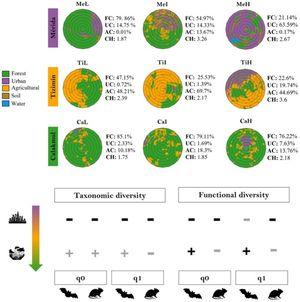
Land-use changes are transforming tropical forests into heterogeneous landscape mosaics with various anthropogenic land covers.
- •
Urban cover is the main landscape factor negatively impacting bat and small rodent taxonomic and functional diversity.
- •
Functional diversity of both taxa decreases with increasing urban cover, filtering out more specialized species.
- •
Forest cover favored some unique functional attributes in bats, increasing their functional diversity.
- •
Preventing urban expansion and deforestation, while maintaining forest cover and forest remnants are urgent strategies.