

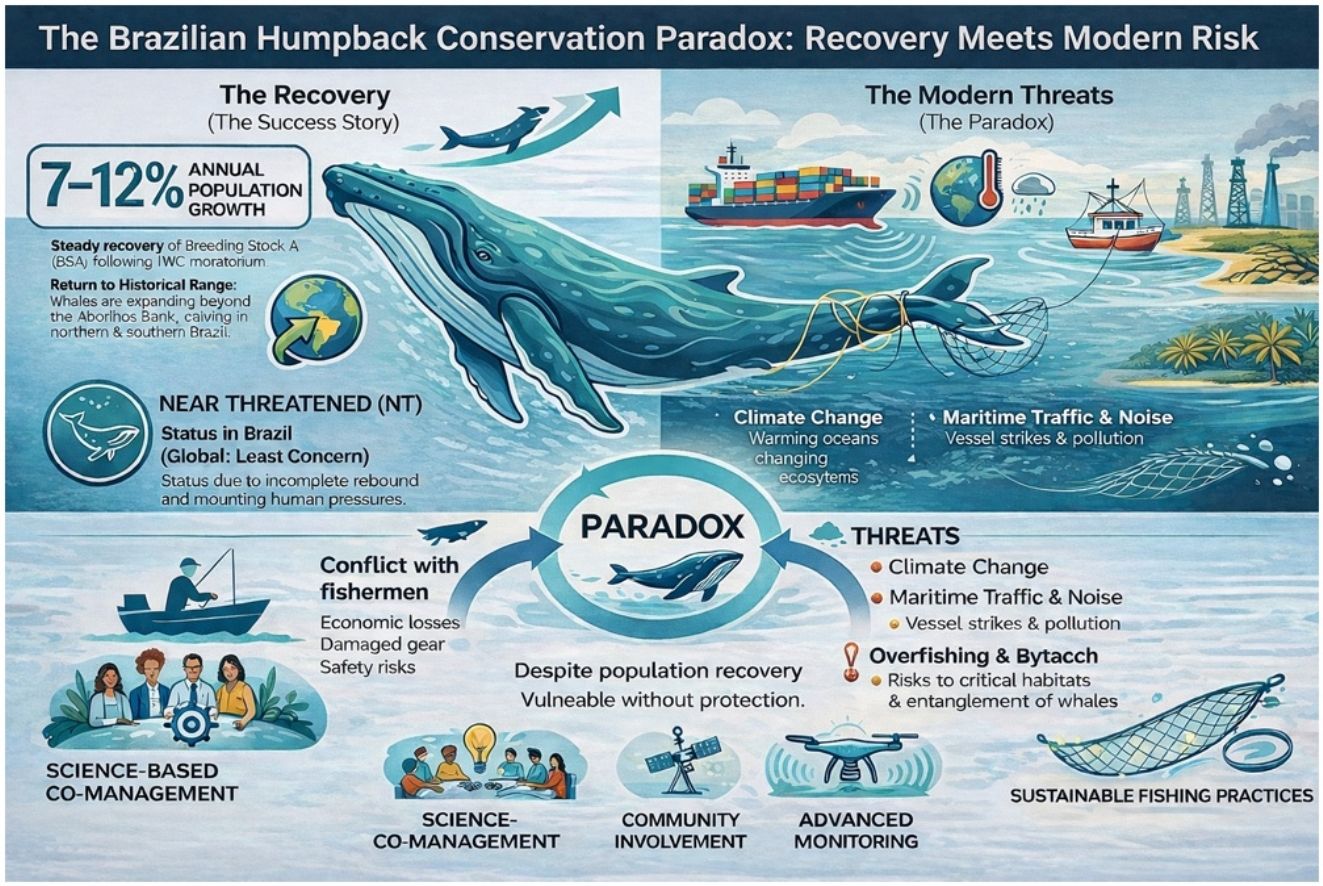
This policy review examines the “conservation paradox” of Brazilian humpback whales (Breeding Stock A): while the population recovers at 7–12% annually and returns to historical habitats, it increasingly overlaps with modernized coastal activities, generating severe socio-environmental conflicts with artisanal fisheries. Unlike previous biologically focused assessments, this review frames the paradox as a governance challenge requiring human-centered mitigation strategies. We analyze existing institutional frameworks—Marine Extractive Reserves (RESEX), the National System of Conservation Units (SNUC), and Brazil’s Marine Spatial Planning (MSP) under Decree 12,491/2025—and evaluate their capacity to operationalize Local Ecological Knowledge (LEK) and multi-stakeholder co-management. We assess monitoring technologies (telemetry, Passive Acoustic Monitoring, drones, AIS, machine learning, eDNA, UAV thermal imaging) not as general tools but as decision-support instruments for specific management processes, with particular attention to operational feasibility for small-scale fisheries. We identify critical governance gaps—including enforcement limitations, underreporting driven by punitive regulatory cultures, and insufficient integration of LEK into formal planning—and propose six concrete policy recommendations. Addressing this paradox requires interdisciplinary, community-inclusive policies that reconcile marine megafauna recovery with local livelihoods and build trust between fishers, regulators, and conservation practitioners.
Humpback whales (Megaptera novaeangliae) belonging to Breeding Stock A (BSA)—the population that breeds along the tropical Brazilian coast during austral winter and spring and migrates to Antarctic feeding grounds—represent a remarkable conservation success. Intensive commercial whaling between the 1960s and 1980s reduced this population by an estimated 90–95%, bringing it to the brink of extinction (Gambell, 1973; Tonnessen and Johnsen, 1982). Following the International Whaling Commission (IWC) moratorium (effective 1966–1986), the population began to recover, progressively returning to historical habitats along Brazil’s coast (Andriolo et al., 2010; Bortolotto et al., 2016; Wedekin et al., 2017; Zerbini et al., 2019). For non-specialist readers, “Breeding Stock A” is a technical designation used by the IWC to identify this distinct population unit; throughout this review, we use “population” to refer to BSA whales.
However, this biological recovery reveals a complex conservation paradox. The major decline in the whale population occurred before the rapid expansion of coastal activities, including maritime traffic, hydrocarbon exploration, and artisanal fisheries. Driven by technological and economic development, these human activities expanded into coastal areas during a period when whale numbers were drastically reduced, and thus this expansion occurred largely without spatial conflict at the time. Consequently, as the population recovers and whales return to their historical breeding habitats, the likelihood of spatial overlap and conflicts with now-established human activities is rising (Andriolo et al., 2010).
This paradox manifests most acutely in socio-environmental conflicts with artisanal fisheries. This recovery has generated socio-environmental conflicts, particularly with artisanal fisheries operating in the same coastal habitats. Solutions must therefore focus on human-centered mitigation without attributing intentionality to the whales (Simmonds, 2006). As apex predators, whales’ size and strength prevent fishermen from resolving conflicts directly; humpback whales can damage fishing gear and pose safety hazards, requiring strategies that balance conservation with local livelihoods (Read, 2008; Tixier et al., 2021). The Brazilian humpback whale population has grown significantly and is no longer classified as Endangered in Brazil (Ministry of the Environment (Brazil) 2014; 2022). Brazil’s legal framework provides strong protection—Federal Law 7.643/87 explicitly bans hunting or harassment of cetaceans, and whale watching is regulated by IBAMA (Ministry of Environment) guidelines—yet enforcement and coverage remain insufficient.
This policy review is organized around the conservation paradox as its central organizing principle. We first summarize the documented biological recovery and spatial expansion (Section ‘Biological recovery and spatial expansion’), then examine the socio-economic impacts on artisanal fisheries in detail (Section ‘Socio-economic impacts on artisanal fisheries’). We analyze governance gaps and institutional frameworks (Section ‘Governance gaps and institutional frameworks’), evaluate monitoring technologies as decision-support tools (Section ‘Monitoring technologies as decision-support tools’), and conclude with concrete policy recommendations (Section ‘Policy recommendations’) and a synthesis (Section ‘Conclusion’). Throughout, we emphasize that addressing this paradox requires moving toward interdisciplinary, community-inclusive policies that reconcile marine megafauna recovery with local livelihoods.
A brief note on the Blue Amazon: in Brazilian policy and maritime discourse, the “Blue Amazon” (Amazônia Azul) refers to Brazil’s Exclusive Economic Zone and extended continental shelf, encompassing approximately 5.7 million km2 of ocean territory. Recognized as a strategic maritime area under Brazilian national policy, the Blue Amazon is central to the country’s Marine Spatial Planning framework and represents the spatial domain within which humpback whale recovery and fisheries conflicts must be managed.
Biological recovery and spatial expansionFollowing protection measures, Brazilian humpback whales have expanded into former breeding sites, demonstrating a return to their historical range. Researchers have observed whales calving both south and north of the well-known breeding area in the Abrolhos Bank, indicating range expansion (Andriolo et al., 2010; Wedekin et al., 2017; Zerbini et al., 2019). Population growth has been documented at 7–12% annually (Andriolo et al., 2010; Bortolotto et al., 2016; Wedekin et al., 2017; Zerbini et al., 2019), approaching pre-exploitation levels in some areas (Wedekin et al., 2017; Zerbini et al., 2019). This recovery represents a conservation success, yet it also sets the stage for the paradox: as the population continues to grow, whales are likely to expand into new areas, increasing the likelihood of spatial overlap with established human activities (Andriolo et al., 2010).
The recovery trajectory is not uniform across all habitats. While the Abrolhos Bank remains the core breeding area, whales are increasingly observed in peripheral coastal zones where artisanal fishing activities are concentrated. This spatial expansion is driven by density-dependent processes as the population approaches carrying capacity in core habitats, pushing individuals into historically used but currently human-occupied areas (Andriolo et al., 2010; Bortolotto et al., 2016). The biological success of the population thus directly contributes to the socio-environmental conflicts examined in the following section.
Socio-economic impacts on artisanal fisheriesGeographic distribution of documented interactionsDocumented interactions between humpback whales and artisanal fisheries are concentrated in the Abrolhos Bank region and adjacent coastal areas, including the municipalities of Ilhéus, Canavieiras, and Corumbau in southern Bahia (Seminara et al., 2019). These areas coincide with both critical breeding habitats for whales and traditional fishing grounds for artisanal communities. The Corumbau Marine Extractive Reserve (RESEX) and Canavieiras RESEX, established to protect both marine ecosystems and artisanal livelihoods, are focal points for whale-fisheries interactions (Cardozo et al., 2012; Cavalcante et al., 2013; Di Ciommo and Schiavetti, 2012; Rocha et al., 2025).
Affected gear typesArtisanal fisheries in these regions employ a variety of gears, including gillnets, longlines, and fish traps. Gillnets are particularly vulnerable to whale interactions: humpback whales can become entangled in nets, damaging or destroying the gear, or can tow nets into deep waters, rendering them unrecoverable (Read, 2008; Seminara et al., 2019). Entanglement occurs when whales swim through or near nets, with baleen plates, flippers, or tail flukes becoming caught in the mesh. It can cause chronic stress, reduced reproduction, and mortality, with necropsies revealing lacerations, infections, and spinal deformities (Aranha and Torres-Florez, 2024; Groch et al., 2018). Sublethal effects such as energy depletion alter migratory success (Cassoff et al., 2011; van der Hoop et al., 2016). Whales often tow gear into deep waters, compounding economic losses for fishers (Read, 2008).
Humpback whales' physical strength means even brief interactions can result in complete loss of gear (Read, 2008). Fishers report that whales sometimes approach nets opportunistically, though there is no evidence of intentional depredation; rather, these interactions reflect spatial overlap in foraging or resting areas (Seminara et al., 2019; Simmonds, 2006).
Frequency of interactionsQuantitative data on interaction frequency remain limited due to underreporting. Fishers often fear penalties under Federal Law 7.643/87, which prohibits harassment of cetaceans, and thus may not report interactions to authorities (Aranha and Torres-Florez, 2024). Available evidence from participatory research in Ilhéus indicates that interactions occur regularly during the whale breeding season (June–November), with some fishers reporting multiple incidents per season (Seminara et al., 2019). The frequency of interactions appears to be increasing as the whale population grows and expands spatially (Andriolo et al., 2010; Seminara et al., 2019).
Economic impactsThe economic impacts on artisanal fishers, while not yet systematically quantified in Brazil, are reported by local communities as substantial (Seminara et al., 2019; Zappes et al., 2013). Direct costs include loss of fishing gear (gillnets can cost several months’ income for small-scale fishers), loss of catch when nets are damaged or towed away, and time lost to repairing or replacing gear (Read, 2008; Seminara et al., 2019). Indirect costs include reduced fishing effort due to fear of further interactions, displacement from traditional fishing grounds, and increased vulnerability to economic shocks in communities already strained by declining fish stocks and climate change (Read, 2008; Tixier et al., 2021). For artisanal fishers operating at subsistence or near-subsistence levels, the replacement cost of lost gear likely represents a significant fraction of seasonal income (Read, 2008), though empirical estimates are lacking for Brazilian fleets. These impacts are compounded by the lack of compensation mechanisms or insurance schemes for gear loss due to whale interactions (Aranha and Torres-Florez, 2024).
Safety risks and social dimensionsBeyond economic losses, whale interactions pose safety risks. Fishers working from small boats report dangerous situations when whales surface near or under vessels, or when attempting to disentangle gear from whales (Seminara et al., 2019; Zappes et al., 2013). The physical power of humpback whales means that fishers cannot resolve conflicts directly, creating a sense of helplessness and frustration (Zappes et al., 2013). These experiences contribute to negative perceptions of whale conservation among some fishing communities, undermining support for protective measures (Seminara et al., 2019; Zappes et al., 2013).
Evidence vs. InterpretationIt is important to distinguish documented evidence from interpretation. The terms 'severe' and 'significant' used in this section reflect fisher-reported perceptions documented in participatory studies (Seminara et al., 2019; Zappes et al., 2013); independent economic quantification of these losses in Brazilian artisanal fisheries has not been published. The evidence base includes: (a) fisher reports of gear damage and loss (Seminara et al., 2019; Zappes et al., 2013); (b) necropsies documenting entanglement-related injuries and mortality in whales (Aranha and Torres-Florez, 2024; Groch et al., 2018); and (c) participatory mapping studies identifying spatial overlap between fishing grounds and whale habitats (Fraga et al., 2022). However, precise quantification of interaction frequency, total economic losses, and population-level impacts on fishers remains limited. The lack of systematic monitoring and the culture of underreporting mean that available data likely underestimate the true scale of the problem (Aranha and Torres-Florez, 2024). Future research should prioritize systematic data collection through co-management frameworks that build trust and reduce fear of penalties.
Governance gaps and institutional frameworksEffective governance of humpback whale–fisheries conflicts requires institutional frameworks that address specific governance problems through targeted mechanisms, under defined conditions. This section evaluates each relevant framework through this three-part logic: (a) what problem it addresses; (b) how it applies to whale–fisheries interactions; and (c) what conditions are necessary for implementation.
Marine Extractive Reserves (RESEX)RESEX were created to reconcile the conservation of marine ecosystems with the livelihoods of traditional extractivist communities, addressing the governance gap between ecological protection and social equity.
The Corumbau Marine Extractive Reserve (established 2000) and Canavieiras RESEX (established 2006) are directly relevant case studies. Corumbau was created through the mobilization of Pataxó fishers and established a deliberative council, including community members, NGOs, and government, to co-manage resources, such as by delineating no-take zones that later enabled fish-stock recovery (Di Ciommo and Schiavetti, 2012). Canavieiras RESEX was co-developed with local extractivists and operates under a governance model that demonstrates legitimacy, voice, and active participation by the extractivist association (Cardozo et al., 2012), with the socio-economic dimensions of community livelihoods also documented (Cavalcante et al., 2013). These examples illustrate how community engagement and shared decision-making boost compliance and stewardship (Cardozo et al., 2012; Cavalcante et al., 2013; Di Ciommo and Schiavetti, 2012). The Abrolhos region highlights how whale-sensitive ecosystems can benefit from economic monitoring and community-driven governance frameworks (Rocha et al., 2025). RESEX councils provide institutional platforms where whale-fishery conflicts can be addressed through participatory planning, such as seasonal fishing restrictions in calving areas or gear modifications to reduce the risk of entanglement.
Successful RESEX governance requires: (a) legal recognition of traditional communities’ use rights; (b) functional deliberative councils with genuine decision-making authority; (c) technical and financial support from government agencies; (d) trust between communities and regulators; and (e) mechanisms for conflict resolution and adaptive management (Cardozo et al., 2012; Di Ciommo and Schiavetti, 2012). Where these conditions are met, RESEX can serve as models for integrating whale conservation with livelihood protection. However, many RESEX face challenges including limited enforcement capacity, insufficient funding, and power imbalances within councils (Di Ciommo and Schiavetti, 2012).
National System Of Conservation Units (SNUC)SNUC provides the legal architecture for Brazil’s protected area network, addressing the need for spatial protection of critical habitats and mandatory participatory governance. SNUC mandates that protected areas covering humpback whale habitats—such as Abrolhos Marine National Park (established 1983) and RESEX—must have management plans and councils. However, these protected areas cover only a small portion of humpback whale habitat (Castro et al., 2014), and management plans do not always explicitly address whale-specific threats such as entanglement or vessel strikes. SNUC provides the legal architecture for participatory governance, but implementation varies widely.
Effective SNUC implementation requires: (a) adequate spatial coverage of critical habitats; (b) management plans that explicitly address whale conservation and fisheries interactions; (c) functional councils with representation from affected communities; (d) enforcement capacity; and (e) integration with broader marine spatial planning (Castro et al., 2014). Current gaps include insufficient coverage of breeding and migratory habitats, weak enforcement, and limited integration of whale-specific management measures into existing protected area plans.
Marine Spatial Planning (MSP)MSP addresses the governance gap arising from uncoordinated sectoral uses of marine space, creating integrated frameworks that balance conservation, economic, and social objectives across ocean territory. Brazil’s Marine Spatial Plan, officially enacted in 2025 through Decree No. 12,491 (Brasil, 2025), covers both the Coastal Zone and the Blue Amazon. MSP provides a framework for integrating whale conservation into broader ocean governance by identifying spatial conflicts, prioritizing areas for protection, and coordinating sectoral activities (fisheries, shipping, oil and gas, tourism). For humpback whales, MSP can inform decisions such as seasonal vessel speed limits in breeding areas, dynamic no-visit zones around calving pods, and spatial allocation of fishing effort to reduce overlap with whale habitats.
Effective MSP requires: (a) comprehensive spatial data on whale distribution, fishing effort, and other human activities; (b) participatory planning processes that include artisanal fishers, indigenous groups, tourism operators, and conservation practitioners; (c) legal authority to enforce spatial management measures; (d) coordination across federal, state, and municipal jurisdictions; and (e) adaptive management mechanisms to respond to changing whale distribution and human activities (Brasil, 2025). Brazil’s MSP is in the early stages of implementation, and its effectiveness for whale conservation will depend on whether whale-specific objectives are integrated into regional plans and whether enforcement mechanisms are developed.
Local Ecological Knowledge (LEK) and co-management councilsCo-management councils address the governance gap between top-down conservation mandates and the lived realities of artisanal fishing communities, enabling the integration of LEK into formal management. Artisanal fishers possess detailed LEK about whale behavior, seasonal presence, and spatial overlap with fishing grounds (Fraga et al., 2022; Zappes et al., 2013). When systematically operationalized in management, LEK can significantly reduce conflict (Zappes et al., 2013). For instance, participatory mapping utilizes fishers’ daily experiences to precisely identify overlap zones between fishing grounds and whale habitats (Fraga et al., 2022). When integrated into co-management councils, this knowledge provides practical mechanisms to reduce conflict: fishers’ insights can directly inform where to deploy technological innovations such as low-breaking-strength gear (Knowlton et al., 2016) or LED-lit nets (Bielli et al., 2020), and help establish localized vessel speed limits or dynamic no-visit zones around calving pods.
A “whale co-management council” could be established that includes artisanal fishers (Seminara et al., 2019), tourism operators, marine biologists, and indigenous groups. Such a forum would allow for the collaborative setting of local management measures. However, underreporting of interactions persists because of fear of penalties (Aranha and Torres-Florez, 2024), highlighting a critical governance gap.
Successful operationalization of LEK and co-management requires: (a) trust-building between fishers and regulators; (b) regulatory frameworks that prioritize learning and adaptive management over punitive enforcement; (c) formal recognition of LEK as legitimate knowledge; (d) capacity-building for participatory processes; (e) financial and technical support for community-based monitoring; and (f) legal authority for councils to influence management decisions (Di Ciommo and Schiavetti, 2012; Fraga et al., 2022; Zappes et al., 2013). The tension between trust-building and punitive enforcement is central: if fishers fear penalties for reporting whale interactions, LEK cannot be effectively integrated, and conflicts remain hidden and unmanaged (Aranha and Torres-Florez, 2024).
International conservation frameworksInternational frameworks address the governance gap arising from the transboundary nature of whale migrations, which require coordinated management across national jurisdictions.
Brazil has led a proposal to establish a South Atlantic Whale Sanctuary under the IWC, arguing that a sanctuary covering high-seas feeding grounds and coastal breeding areas would help safeguard migratory routes. Although not yet approved, this initiative highlights Brazil’s dedication to ecosystem-based management. Brazil also participates in the IWC’s Conservation Management Plan (CMP) process for South Atlantic cetaceans and is a signatory to the Convention on Migratory Species (CMS).
Effective use of IWC frameworks requires: (a) national commitment to international agreements; (b) coordination between national and international conservation priorities; (c) data sharing and regional monitoring networks; and (d) translation of international commitments into domestic policy and enforcement (Brasil, 2025).
Brazilian legal instrumentsDomestic legal instruments address the governance gap between species protection mandates and sectoral management of fisheries and maritime activities. Federal Law 7.643/87 explicitly bans hunting or harassment of cetaceans, providing strong legal protection but creating fear of penalties that inhibit reporting of accidental interactions (Aranha and Torres-Florez, 2024). Law 11.959/2009 establishes Brazil’s Ecosystem Approach to Fisheries, calling for cautious management of marine megafauna, but implementation remains limited. Enforcement of bycatch reduction measures and Fisheries Observer programs (which could incidentally record whale interactions) is weak.
Effective legal frameworks require: (a) clear distinction between intentional harassment and accidental interactions; (b) enforcement capacity; (c) mechanisms for reporting and learning from interactions without punitive consequences; (d) integration of whale conservation objectives into fisheries management plans; and (e) coordination between environmental and fisheries agencies (Aranha and Torres-Florez, 2024; Brasil, 2025).
Summary of governance gapsKey governance gaps include: (a) insufficient spatial coverage of protected areas relative to whale habitat (Castro et al., 2014); (b) weak enforcement of existing regulations; (c) punitive regulatory culture that inhibits reporting and learning (Aranha and Torres-Florez, 2024); (d) limited integration of LEK into formal planning (Fraga et al., 2022; Zappes et al., 2013); (e) lack of compensation mechanisms for gear loss due to whale interactions (Aranha and Torres-Florez, 2024); (f) insufficient coordination between environmental and fisheries agencies; (g) absence of systematic monitoring of whale-fisheries interactions; and (h) limited capacity for adaptive management in response to changing whale distribution and human activities (Andriolo et al., 2010; Brasil, 2025). Addressing these gaps requires institutional reforms that prioritize trust-building, participatory governance, and interdisciplinary approaches.
Monitoring technologies as decision-support toolsMonitoring technologies are valuable to the extent that they support specific management decisions in MSP, RESEX management, or co-management councils. This section evaluates each relevant technology through this lens, with particular attention to operational feasibility for small-scale artisanal fisheries.
Telemetry and population monitoringTelemetry data are crucial for mapping whale habitat use, recognizing behavioral responses to human activities, and identifying spatial overlap with fishing grounds. Telemetry-derived distribution models can directly inform MSP decisions, such as delineating seasonal management zones and allocating fishing effort spatially. For RESEX management, telemetry data can identify critical breeding and calving areas where fishing restrictions would be most effective. Telemetry is operationally feasible as a scientific monitoring tool, but requires investment in tagging programs and data analysis capacity.
Passive Acoustic Monitoring (PAM)PAM networks can provide real-time information on whale presence and distribution, supporting MSP decisions and RESEX management. Fixed arrays of acoustic recorders can alert managers when whales enter critical zones, similar to marine mammal alert systems used elsewhere. Acoustic data can also measure noise levels and evaluate the effects of shipping lanes or seismic surveys on whale behavior.
However, the use of PAM for real-time whale detection as a mitigation tool for artisanal fisheries requires critical evaluation of operational feasibility. If a fisher already has a net deployed when a whale detection alert is issued, the time available to retrieve the gear before an interaction occurs may be insufficient, given the speed of whale movement and the logistical constraints of small-scale vessels (limited crew, engine power, and navigation equipment). Real-time detection systems are therefore more appropriate as pre-deployment planning tools (informing whether and where to deploy gear on a given day) or as inputs to seasonal and spatial management decisions (informing closures during peak whale presence) rather than as emergency response tools. For artisanal fisheries, the most operationally feasible applications of PAM are community-based monitoring programs where fishers are trained to use portable acoustic devices to assess whale presence before deploying gear.
Drones (UAVs) and aerial monitoringUnmanned aerial vehicles (UAVs) can supplement telemetry by capturing photogrammetry images of whales to estimate body condition and count calves with minimal disturbance. For co-management councils, drone-based monitoring can provide accessible visual evidence of whale-fisheries spatial overlap, supporting participatory decision-making. UAV thermal imaging can detect whale presence in low-visibility conditions, potentially informing pre-departure decisions for fishers. UAVs are relatively low-cost and operationally simple compared to vessel-based surveys, making them feasible for use by RESEX management agencies or trained community monitors.
AIS and vessel traffic analysisSatellite automatic identification system (AIS) data can be combined with whale location data to assess collision risk and inform vessel routing decisions within MSP frameworks. AIS-based analysis can identify high-risk zones where whale distribution overlaps with busy shipping lanes or fishing vessel routes, supporting the design of seasonal speed limits or routing guidelines. AIS is already mandatory for vessels above a certain size in Brazilian waters and requires no additional equipment for most commercial vessels.
Machine learning and Big dataAutomated machine-learning detectors can analyze years of acoustic recordings to efficiently identify whale calls, dramatically reducing the analytical burden on PAM programs. Machine learning models trained on satellite imagery or AIS data can predict spatial overlap between whales and fishing activities, providing decision-support tools for MSP and RESEX management. These tools require significant investment in data infrastructure and technical capacity, but their outputs can be made accessible to co-management councils through user-friendly dashboards or mobile applications.
Emerging techniques: eDNA and UAV thermal imagingEnvironmental DNA (eDNA) sampling and UAV thermal imaging are emerging techniques with potential for non-invasive, cost-effective monitoring of whale presence and distribution. While still in development for routine use in Brazilian waters, these techniques could complement traditional methods and provide accessible monitoring options for community-based programs. Their operational feasibility for artisanal fisheries contexts will depend on the development of simplified sampling protocols and data analysis tools.
Gear modifications as low-technology solutionsFor artisanal fisheries, low-technology gear modifications may be more operationally feasible and immediately impactful than high-technology monitoring systems. Low-breaking-strength fishing ropes can reduce life-threatening entanglements in whales by at least 72% (Knowlton et al., 2016), and LED-lit nets have achieved a 50% deterrence rate in Mexico (Bielli et al., 2020). However, these modifications require subsidies and technical support for adoption by small-scale fishers, and their implementation should be coordinated through co-management councils to ensure community acceptance and adaptive management.
Policy recommendationsBased on the governance gaps and evidence reviewed above, we propose the following six concrete policy recommendations for reconciling humpback whale conservation with artisanal fisheries livelihoods in Brazil.
- 1
Establish a Safe Reporting System for Accidental Whale Interactions. Fear of penalties under Federal Law 7.643/87 discourages reporting of accidental whale interactions, hindering learning and adaptive management (Aranha and Torres-Florez, 2024). A regulatory culture that distinguishes intentional harassment from accidental interactions and treats reporting as a learning opportunity rather than a violation is essential to operationalizing LEK and building trust. Amend implementing regulations to establish a formal, non-punitive reporting mechanism for accidental entanglements, administered jointly by IBAMA and the Ministry of Fisheries and Aquaculture (MPA), with data used for adaptive management rather than enforcement.
- 2
Expand and Empower Co-Management Councils in RESEX Areas. RESEX such as Corumbau and Canavieiras already have functional deliberative councils and community engagement (Cardozo et al., 2012; Cavalcante et al., 2013; Di Ciommo and Schiavetti, 2012). Expanding council mandates to explicitly address whale-fisheries interactions would provide institutional platforms for collaborative planning, LEK integration, and adaptive management. Issue directives requiring RESEX councils in the Abrolhos region and adjacent coastal areas to develop whale-fisheries interaction management plans, with genuine decision-making authority over local management measures.
- 3
Integrate Whale Conservation Objectives into Brazil’s Marine Spatial Planning. Brazil’s MSP framework (Brasil, 2025) provides a legal and institutional platform for coordinating whale conservation with fisheries, shipping, and other sectors across the Blue Amazon. However, whale-specific objectives must be explicitly integrated into regional MSP plans to be effective. Develop a dedicated whale conservation layer within the national MSP framework that identifies critical breeding and migratory habitats, spatial conflict zones, and priority areas for seasonal management measures.
- 4
Expand Protected Area Networks to Cover Critical Whale Habitats. Current protected areas (Abrolhos Marine National Park and RESEX) cover only a small portion of humpback whale habitat (Castro et al., 2014). As the population expands spatially, protected area networks must be expanded to include newly occupied breeding and calving areas. Commission a systematic review of humpback whale habitat use along the Brazilian coast, and use the results to guide the designation of new RESEX or other SNUC categories in priority areas.
- 5
Subsidize Gear Modifications for Small-Scale Fishers. Low-tech, community-based approaches are more operationally feasible and socially acceptable for small-scale artisanal fisheries than high-tech monitoring systems. Gear modifications (e.g., low-breaking-strength lines) can reduce the risk or severity of entanglement (Bielli et al., 2020; Knowlton et al., 2016), but adoption requires subsidies and technical support. Establish a federal subsidy program for gear modifications in RESEX and coastal communities with documented whale-fisheries conflicts, administered through RESEX councils to ensure community participation and adaptive management.
- 6
Invest in Systematic Monitoring and Data Infrastructure. The current lack of systematic data on whale-fisheries interactions limits adaptive management and policy development. Investment in long-term monitoring programs will help ensure that population trends are well documented and enable management to adapt to new threats, such as changes in prey abundance or the impact of ocean heatwaves on whale distribution. Establish a national whale-fisheries interaction monitoring program that integrates scientific monitoring (telemetry, PAM, UAV surveys) with community-based monitoring through co-management councils. Make data accessible to co-management councils via user-friendly platforms.
The Brazilian humpback whale population embodies a genuine conservation paradox: a species once nearly wiped out is now thriving, yet its biological success generates new governance challenges for vulnerable coastal communities. We have shown that the 7–12% annual population growth and spatial expansion into former breeding sites along the Brazilian coast (Andriolo et al., 2010; Bortolotto et al., 2016; Wedekin et al., 2017; Zerbini et al., 2019) have generated severe socio-economic impacts on artisanal fisheries, particularly in the Abrolhos Bank region and adjacent RESEX areas (Read, 2008; Seminara et al., 2019; Zappes et al., 2013). These impacts—gear damage, economic losses, safety risks—are compounded by governance gaps including insufficient protected area coverage (Castro et al., 2014), weak enforcement, punitive regulatory cultures that inhibit reporting (Aranha and Torres-Florez, 2024), and limited integration of Local Ecological Knowledge into formal planning (Fraga et al., 2022; Zappes et al., 2013).
Existing institutional frameworks—Marine Extractive Reserves (RESEX), the National System of Conservation Units (SNUC), and Brazil’s Marine Spatial Planning (MSP) under Decree 12,491/2025 (Brasil, 2025)—provide legal and institutional platforms for addressing whale-fisheries conflicts, but their effectiveness depends on trust-building, participatory governance, and adaptive management. Monitoring technologies (telemetry, PAM, drones, AIS, machine learning, eDNA, UAV thermal imaging) offer valuable decision-support tools for MSP, RESEX management, and co-management councils, but are not panaceas; low-tech, community-based approaches may be more operationally feasible for small-scale artisanal fisheries.
Resolving the conservation paradox requires moving beyond isolated solutions toward a comprehensive, ecosystem-based, and precautionary approach. Such a framework must be adaptable, science-led, and inclusive of the coastal communities that share their habitat with recovering whales. The six policy recommendations proposed here—safe reporting systems, expanded co-management councils, MSP integration, protected area expansion, gear modification subsidies, and systematic monitoring—offer a concrete roadmap for turning the conservation paradox from a problem into an opportunity for governance innovation. Only through interdisciplinary, community-inclusive policies can the long-term recovery of Brazil’s humpback whale population be reconciled with the livelihoods of artisanal fishing communities that depend on the same coastal ecosystems.
Declaration of Generative AI and AI-assisted technologies in the writing processDuring the preparation of this work, the author used the free version of ChatGPT to organize citations and references and to produce the Graphical Abstract, and Grammarly Premium was used to revise spelling and language structure. SciSpace was used for the revision in the second round. After using these tools, the author reviewed and edited the content as needed and takes full responsibility for the content of the published article.
FundingThis research did not receive any specific grant from funding agencies in the public, commercial, or not-for-profit sectors.
CRediT authorship contribution statementArtur Andriolo: Writing – review & editing, Writing – original draft, Project administration, Methodology, Investigation, Conceptualization.
The author declares no conflicts of interest related to the content of this text.