

The current global scientific landscape is structured as a hierarchy that prioritises Global North epistemologies while treating knowledge from the Global South as peripheral. This exclusion is maintained through three primary pillars of inequity: academic dependency, linguistic and financial gatekeeping, and extractive research practices. In the face of planetary-scale crises, we cannot afford to ignore the insights of most of the world’s population due to systemic imbalances. Here we contextualise the Brandt Line’s legacy and argue that the exclusion of southern voices is a critical scientific integrity issue that limits our ability to solve global challenges. To address current asymmetries, we propose a strategy of seven complementary pathways requiring coordinated action by both southern and northern stakeholders. Ultimately, achieving true sustainability requires a scientific ecosystem that is as diverse, representative, and resilient as the planet it seeks to protect.
The Global North (GN) - Global South (GS) divide, rooted in the Brandt Line model, reflects an enduring geopolitical and epistemological imbalance that continues to shape academic research and knowledge production (Heath, 1981). Its legacies are structurally embedded in academia, privileging countries primarily in the northern hemisphere while marginalising most of the southern hemisphere.
The enduring belief that science originated in the West and spread outward as a civilising force has facilitated a form of knowledge colonialism that highlights historical inequalities while reinforcing an entrenched association between geopolitical power and knowledge production, thereby establishing a status quo of epistemic dominance and shaping global academic standards (Dados and Connell, 2012). Despite increasing calls for decolonising science, efforts to dismantle these epistemic hierarchies remain limited (Hirschfeld et al., 2023; Speziale et al., 2026). Bridging this divide is not only a matter of equity but of scientific integrity: addressing today’s pressing global challenges, from biodiversity loss to climate change, requires the inclusion of diverse epistemologies, local contexts, and situated expertise. Here, we reflect on the academic dependencies and structural inequities that challenge researchers in the GS and suggest transformative strategies for building a more inclusive, just, and globally collaborative scientific future.
Academic dependenciesResearch agendas, methodologies, and success metrics remain tethered to the GN's epistemic norms in many GS contexts. In general, GS researchers need to use these GN metrics without local calibration due to the lack of funding and/or baseline research, thus making it difficult to understand local processes and make context-specific decisions. This dynamic, captured in academic dependency theory, reflects intellectual subordination and the internalisation of northern paradigms as standards for legitimacy (Alatas, 2003), paralleling the broader GS-GN divide and influencing various aspects of academic life.
One critical manifestation of this dependency is the prestige associated with foreign training, where scientists trained in Europe or North America often receive disproportionate recognition, institutional preference, and greater career mobility, while overlooking equally capable peers trained locally (Verginer and Riccaboni, 2021). Beyond intrinsic salary disparities between GS and GN academic institutions, this widely perceived prestige gap fuels a persistent “brain drain” and perpetuates the myth that quality science is a GN attribute (Verginer and Riccaboni, 2021). The implications are twofold: GS institutions struggle to retain talent, and their unique research priorities, often aligned with local ecological or societal needs, are devalued in global discourses.
Equally concerning is the absence of robust mentorship cultures in many GS institutions (Lescano et al., 2019), which is essential to developing critical thinking, professional networks, and long-term scientific careers (Deanna et al., 2022). However, it is often an unfunded, informal, or neglected element in academic ecosystems that are under-resourced and overburdened. Without structural support for mentorship, early-career scientists face steep career progression obstacles, reinforcing generational inequities.
Colonialist standards and normsThe GN dominance has historically marginalised the knowledge systems, epistemologies, and contributions of the GS, which is evidenced by the underrepresentation of GS scholars in leadership roles across journals, institutions, and scientific committees (Skopec et al., 2020). Implicit biases in the peer-review process compound economic and linguistic inequalities, with the English linguistic hegemony exacerbating these disparities.
Most high-impact journals are published by editorial houses based in GN countries, where submissions in non-English languages are rarely considered or cited (Amano et al., 2023). GS researchers often feel compelled to prioritise these journals over national or regional outlets, in pursuit of broader international visibility (Skopec et al., 2020). Despite conducting high-quality research under resource-constrained conditions, GS scholars often face harsher reviews, being frequently asked to invest in professional English-editing services to meet the expectations of ‘native’ fluency (Skopec et al., 2020; Turba et al., 2026). Recent advances in AI-based language tools may help reduce some of these barriers by improving manuscript clarity and readability. However, writing and revising scientific work in a second language still requires additional time and effort, and access to these technologies does not eliminate the broader structural inequalities shaping scientific communication. These barriers can limit GS researchers' publication output, reinforcing systemic exclusion and contributing to phenomena such as impostor syndrome and chronic underrecognition.
Ironically, much of the literature published in such venues remains behind paywalls, often inaccessible to readers and authors from the GS, perpetuating a paradoxical cycle where knowledge production and its dissemination are concentrated in the GN (Burgman, 2019). Although many journals have shifted to Open Access (OA) models to bypass paywalls, this transition has introduced prohibitively high Article Processing Charges (APCs) for many GS countries. Thus, while OA aims to democratise access to scientific knowledge, it reinforces existing inequalities by privileging those with financial means (Burgman, 2019).
Further, researchers in the GS often face significant barriers to visibility in international scientific communities. High registration costs for conferences/workshops/meetings, combined with the financial and temporal burdens of obtaining travel visas, frequently limit participation (Shaw et al., 2025). In addition, the dominance of English-language proficiency as a prerequisite for effective engagement discourages some scholars from attending altogether (Amano et al., 2023). These intersecting challenges not only reduce the visibility of science produced by GS researchers but also constrain the diversity of perspectives within global scientific discourse, ultimately impeding the collective advancement of knowledge (Turba et al., 2026).
Beyond these structural issues, extractive scientific practices, often referred to as "helicopter" or "parachute" research, continue to undermine the role of GS scholars. In such cases, GN researchers collect data in GS countries with logistical support from local collaborators. Yet, the latter are frequently omitted from authorship or downstream project decisions (Haelewaters et al., 2021). Despite being key stakeholders, GS scientists are routinely excluded from disseminating and applying those research outcomes (Haelewaters et al., 2021).
Lack of Government Support for Science and TechnologyIn many GS countries, scientists operate in political landscapes marked by scientific denialism, chronic underfunding, and a lack of institutional support for research and innovation (Diele-Viegas et al., 2021). According to UNESCO (UNESCO, 2023), GS's average Gross Domestic Expenditure on Research and Development (GERD) is approximately 0.40% of GDP, significantly lower than GN's average of 1.5%. This discrepancy translates into limited career opportunities, inadequate salaries, scarce research funding, and persistent infrastructural deficiencies.
Political instability and abrupt policy shifts further disrupt scientific agendas, with grants delayed, reduced, or canceled (Diele-Viegas et al., 2021). The impact of low investment in science is especially pronounced in disciplines requiring access to advanced and expensive laboratory equipment, licensed software, long-term fieldwork (especially in remote areas), or subscription-based scientific platforms. For early-career researchers and those in less economically developed regions, these conditions significantly limit the feasibility and competitiveness of their research. These internal inequalities restrict the national distribution of scientific capacity and opportunity, often reflecting broader inequalities in economic and social infrastructure, including healthcare, education, and public services, which in many GS nations are under-resourced and overburdened.
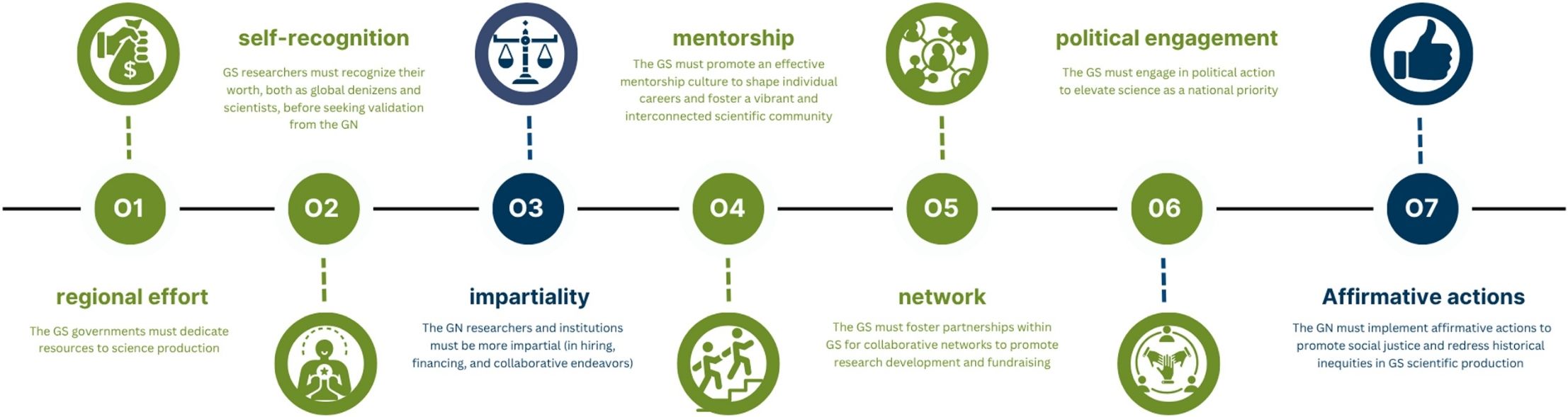
Addressing barriers and advancing equity in GS scienceOvercoming the obstacles faced in the GS requires structural reforms and a shift in how scientific excellence is recognised and supported globally. Coordinated action is needed on multiple fronts to address these systemic barriers and advance equity in science. As summarised in Fig. 1, seven complementary pathways, each requiring action by GS and/or GN actors, can help reconfigure current asymmetries in global science and form a roadmap toward a more just, inclusive, and collaborative scientific ecosystem.
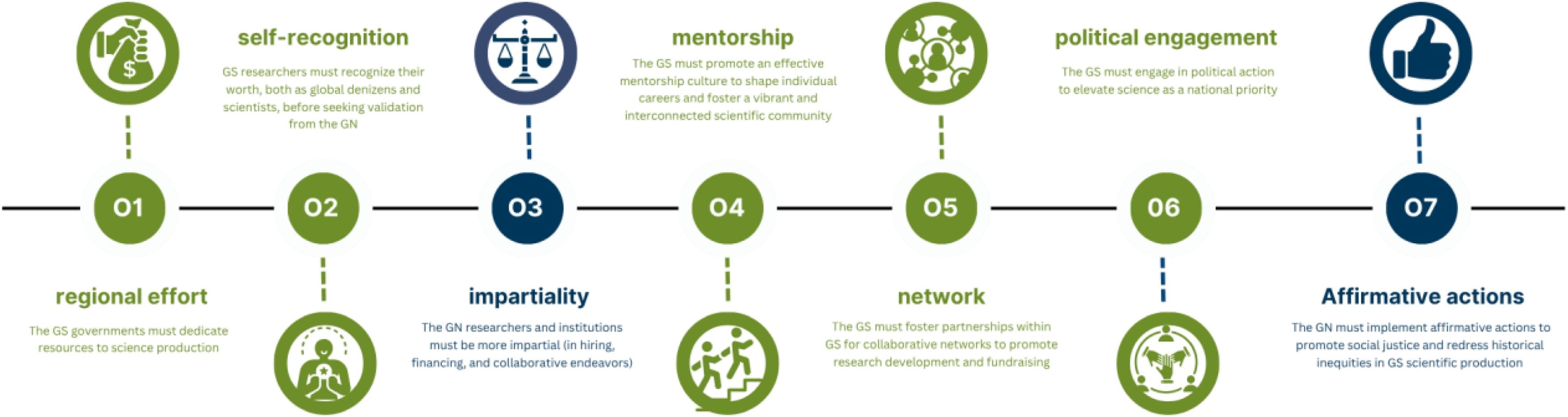
Pathways to equity in Global South science. Seven interconnected actions, from regional investment and intra-South networks to GN-led reforms like affirmative action, can help rebalance power in global knowledge production. Coordinated efforts across institutions, governments, and researchers are essential to dismantle structural barriers and foster inclusive scientific systems.
A crucial first step is to resist the default deference to the GN as the epistemic authority, which involves decolonising research imagination and execution (Nguyen and Chia, 2023), and valuing the remarkable scientific output from the GS, often produced with minimal resources, yet delivering innovative and impactful solutions (Gonzalez-Brambila et al., 2016). However, operating under chronic austerity is not a virtue, but a symptom of structural neglect. Thus, the disparity must be confronted, not glorified.
Governments in the GS must also commit to sustained investments in science and technology, decoupled from political instability. Maintaining consistent support for research institutions is essential for long-term development, particularly because changes in government (election cycles) can alter public research priorities and disrupt policy continuity (Cortés and Ramírez Cajiao, 2024). International financial agencies might play a key role in this endeavor, conditioning loans on investment in education and science, independent of a current government’s ideology. At the same time, researchers must have opportunities to shape science policy by engaging with political stakeholders, contributing to public debates, and making science visible in broader society (Lambertucci et al., 2025). Writing for newspapers and magazines, participating in media discussions, and organising open, jargon-free events are powerful ways to embed science in public discourse and elevate its status as a national priority.
Another key priority should be shifting the emphasis in scientific publishing from linguistic perfection to the quality of scientific content. Journals should take greater responsibility for translation and language editing, particularly for authors facing systemic barriers (Turba et al., 2026). Integrating language-proofing tools into preprint platforms, expanding editorial services, and responsibly incorporating AI-based translation and editing tools with human oversight are practical ways to foster inclusivity and reduce linguistic bias (Khelifa et al., 2022; Turba et al., 2026). A more inclusive scientific community must also extend to publishing models. Open diamond models or even hybrid systems allowing OA and subscription options, accompanied by full APC waivers (or significant, context-aware discounts), can help avoid economic exclusion (Turba et al., 2026). Editorial boards should reflect geographic and demographic diversity as well, aiming for at least 50% GS representation. Multi-editorial decision-making processes and triple-anonymised peer review can reduce bias, while editorial transparency, open-access vouchers, and support for outreach in authors’ native languages can democratise scientific knowledge (Turba et al., 2026). Furthermore, encouraging multilingualism at scientific fora can enhance the accessibility and legitimacy of diverse research traditions (Turba et al., 2026). These measures can help integrate knowledge produced in the GS into the global academic discourse, thereby contributing to a more equitable and representative body of scientific knowledge (Amano et al., 2023; Choi et al., 2025).
National and cross-border programs connecting early-career GS scientists with experienced mentors can bridge knowledge gaps and promote a culture of collaboration and mutual support (Deanna et al., 2022). Such networks can bridge critical gaps in knowledge, foster collaborative thinking, and create a culture of support in often isolated academic environments. For example, the Intergovernmental Science-Policy Platform on Biodiversity and Ecosystem Services (IPBES; www.ipbes.net) Fellowship Programme provides opportunities for early-career researchers to participate in assessments and receive mentorship from senior experts. The programme also provides financial support to fellows from the Global South to facilitate their participation in author meetings and capacity-building activities (e.g., https://www.ipbes.net/ipbes-fellowship-programme). Similarly, The World Academy of Sciences (TWAS), based in Trieste, Italy, works towards the advancement of science in developing countries by responding to the needs of early career researchers in such countries, and promoting South-South and South-North cooperation in science, technology and innovation (https://twas.org/).
It is equally important for GS institutions to strengthen collaborations within the South itself. Networks promoting mutual support, joint fundraising, co-authorship, and sharing opportunities, especially with marginalised groups inside academia, can create a collective power base less dependent on GN structures. Institutions must adopt affirmative action measures for scholarships, grants, conference participation, and mobility support that serve as historical reparations and strategic investments in a more just and diverse scientific future.
Successful regional networks demonstrate the feasibility and real-world impact of these collaborative frameworks. For instance, the Human Heredity and Health in Africa Consortium (https://h3africa.org/) exemplifies an African-led initiative that combined research funding with bioinformatics training, biobanking, ethical governance, data infrastructure, and scientific coordination to foster sustainable scientific careers. Beyond intra-academic networks, the private sector and industry within Global South countries can also play a pivotal role in strengthening local scientific development. Engaging industry with research institutions fosters innovation, economies of scale, and alternative financing, thereby reducing reliance on volatile public funding. In Brazil, models like EMBRAPII (https://embrapii.org.br/) support pre-competitive R&D projects carried out jointly by companies and accredited research units using public non-reimbursable funds paired with corporate contributions to reduce technological risk. Similarly, collaborations between large private companies, universities, and NGOs (such as Petronas and ANP R&D grant challenges) utilize science-based approaches to solve environmental issues while advancing the bioeconomy.
However, industry engagement must not be equated with commercializing all research. Partnerships should be governed by transparent agreements addressing intellectual property, authorship, data access, benefit-sharing, conflicts of interest, and research independence. Particular attention is required to prevent private investment from redirecting national research agendas exclusively toward commercially profitable topics or reproducing extractive dynamics within the GS. When embedded in national and regional innovation strategies with robust ethical oversight, university-industry partnerships can strengthen local value chains, retain highly trained researchers, support technology transfer, and amplify the influence of scientific evidence on public policy and sustainable economic development. Such partnerships can complement public investment in science, but they should never absolve governments of their responsibility to maintain sustained public funding for research.
Finally, fostering interdisciplinary collaborations is essential to promoting innovation and developing comprehensive solutions to complex challenges. Institutions and funding bodies should explicitly support projects that integrate different perspectives and knowledge systems. Notably, while we emphasise GN-GS disparities, we also recognise the marginalised voices within both contexts, particularly Indigenous scholars historically excluded from science (Halsey et al., 2020). Solidarity must also be built across shared experiences of systemic exclusion. For example, IPBES specifically calls for scholars who represent and/or work with Indigenous Peoples and Local Communities when seeking experts, and for organizing multiple dialogues with Indigenous and Local Knowledge Holders during the assessment writing process to ensure the inclusion and integration of different knowledge systems (IPBES, 2017).
The divide between GN and GS is not merely geographical or symbolic: it is rooted in enduring colonial and capitalist legacies. As a public good, science must reflect normative values such as justice and equality to generate better, more inclusive science. Turning this tide requires commitments across all levels: GS governments must prioritise and invest in science, GS researchers must build collective power without reproducing exclusion, and GN counterparts must actively dismantle barriers and take responsibility for historical redress.
Authors contributionsLMDV: Conceptualization, Formal analysis, Investigation, Methodology, Project administration, Resources, Supervision, Validation, Visualization, Writing – original draft, Writing – review & editing; AS: Conceptualization, Investigation, Methodology, Project administration, Supervision, Writing – original draft, Writing – review & editing; FDS: Investigation, Writing – original draft, Writing – review & editing; AB: Conceptualization, Writing – original draft, Writing – review & editing; SAL: Conceptualization, Writing – original draft, Writing – review & editing; LS: Writing – review & editing; MAA: Conceptualization, Writing - review & editing; LEOG: Writing - review & editing; TM: Conceptualization, Investigation, Methodology, Writing – original draft, Writing – review & editing; MSP: Writing – original draft, Writing – review & editing; VSSP: Writing – review & editing; FRM: Writing – original draft, Writing – review & editing; GSG: Writing – review & editing; SS: Writing – review & editing; SS: Writing – review & editing; BES: Writing – review & editing; JSS: Investigation; Writing – review & editing; DGZ: Writing – review & editing; SAS: Writing – review & editing. FV: Investigation, Methodology, Project administration, Validation, Visualization, Writing – original draft, Writing – review & editing.
All authors declare no competing interests.
We thank Ana Carolina de Lima Barizão, Andrea Echeverry-Alcendra, Ayan Ahmed, Dolors Armenteras Pascual, and Yohana M. Velasco-Santamaría for their insights in previous versions of this manuscript. All opinions expressed are those of the authors and do not reflect the views of their affiliated institutions.