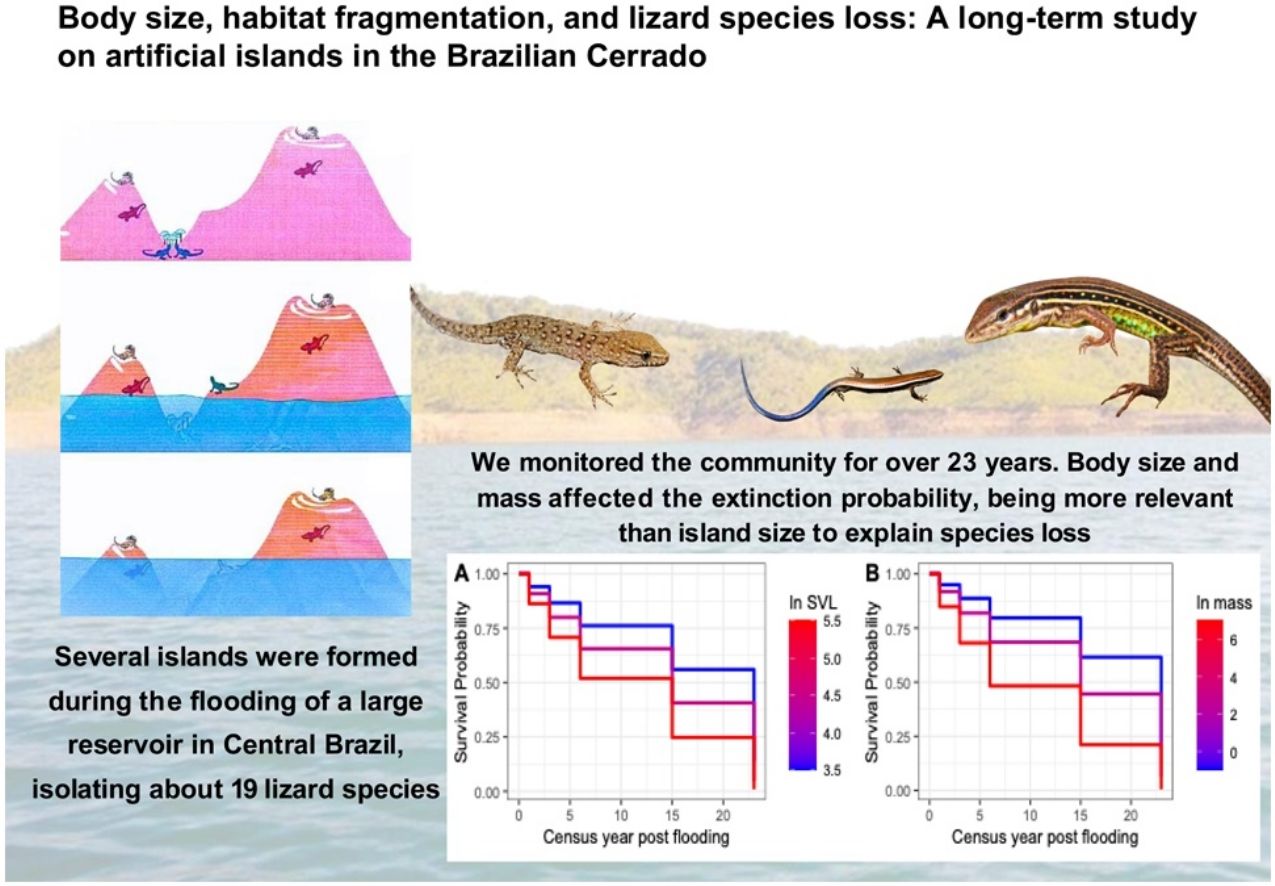

Habitat fragmentation often leads to local extinctions and species turnover, but the mechanisms that allow some species to persist while others go extinct remain poorly understood. Land-bridge islands created by reservoir flooding, a severe form of fragmentation caused by hydroelectric dams, are a valuable model for studying these impacts. When terrestrial habitats are flooded, hilltops become isolated islands, leading to dramatic structural changes in ecosystems. We used the lizard community in Serra da Mesa to evaluate species’ sensitivity to such changes over 23 years of monitoring, spanning before, during, and after flooding. Lizard diversity declined from 19 species to six on land-bridge islands and mainland areas near the reservoir. Large-bodied species (e.g., Teiidae) decreased sharply on islands, where small-bodied species (e.g., Gekkonidae) thrived. This shift resulted in island, but not mainland communities being dominated by one highly abundant species, Gymnodactylus amarali. Smaller species may have advantages on islands due to lower energy demands and secretive habits. These findings highlight the importance of fragment size in conserving biodiversity. Hydroelectric dams, while considered clean energy, cause significant habitat loss and fragmentation. Our results provide critical insights for mitigating declines in wildlife and emphasize the need for careful planning to preserve biodiversity during reservoir formation.
Biodiversity decline is a major consequence of habitat destruction (Fahrig 2002). Habitat fragmentation, the breakup of continuous habitat into scattered patches, is a common form of degradation caused by both natural and anthropogenic factors (Crooks et al. 2017). In tropical developing regions, river damming often leads to habitat insularization, causing extreme disturbance, species turnover, and significant changes in local diversity (Cosson et al. 1999; Palmeirim et al. 2018, 2021).
Theoretical models (Simberloff 1974; Wilcox 1978) and empirical studies (Jones et al. 2016; Palmeirim et al. 2017) predict species loss during land-bridge island formation after damming. However, why some species are lost from local communities, whereas some of them are capable of remaining, is still uncertain. In Thailand, the most common rodent species showed the greatest declines in occurrence post-flooding, whereas rarer species increased in abundance, likely due to declines in predators (Lynam 1997). This suggests that initial abundance poorly predicts persistence on new islands, and that local extinction risk is instead explained by other factors. For instance, Kemp and Hadly (2015) reported that, despite higher dispersal abilities of larger animals (Jenkins et al., 2007), Quaternary extinctions in Caribbean Island lizards increased with body size. Similarly, larger lizard species disappeared from local communities more quickly in an island colonization-extinction experiment (Schoener and Schoener 1983). Meanwhile, MacArthur and Wilson’s (1967) equilibrium theory of island biogeography predicts greater extinction rates in smaller habitats, and lower colonization rates in those that are more isolated.
Reservoir land-bridge islands are key models for studying the effects of isolation on various taxa, including mammals, amphibians, birds, and trees (Palmeirim et al. 2018; Brandão & Araujo 2008; Yu et al. 2012; Terborgh et al. 2006). Lizards, recently studied in this context (e.g., Palmeirim et al. 2017, 2021; Miranda et al. 2023), are ecologically diverse, low-dispersal ectotherms that are sensitive to habitat changes and serve as prey, predators, and seed dispersers (Gainsbury & Colli 2019; Terborgh et al. 2001). These traits make them excellent models for identifying traits linked to persistence in fragmented areas, aiding conservation planning (Palmeirim et al. 2017).
This study uses over 23 years of monitoring data from the Serra da Mesa hydroelectric reservoir in central Brazil to investigate the ecological drivers of flooding-related changes in lizard community composition and species persistence. We analyzed ecomorphological traits of lizard species present before the dam’s flooding and examined patterns of species loss. Two datasets were assessed: morphological traits explaining species persistence and abiotic island traits, including size and isolation. We explored: 1) patterns of species diversity loss during flooding, 2) differences in species persistence rates between islands and the mainland, 3) the effects of island size and isolation on species persistence, and 4) whether body size predicts species persistence. Based on previous results (MacArthur and Wilson 1967; Schoener and Schoener 1983; Kemp and Hadly 2015), we hypothesize (i) that the loss of species diversity would vary with island size and isolation after flooding in concordance with the equilibrium theory of island biogeography; and (ii) that habitat fragmentation would impact species differently, with larger lizards experiencing significant declines on Serra da Mesa artificial islands.
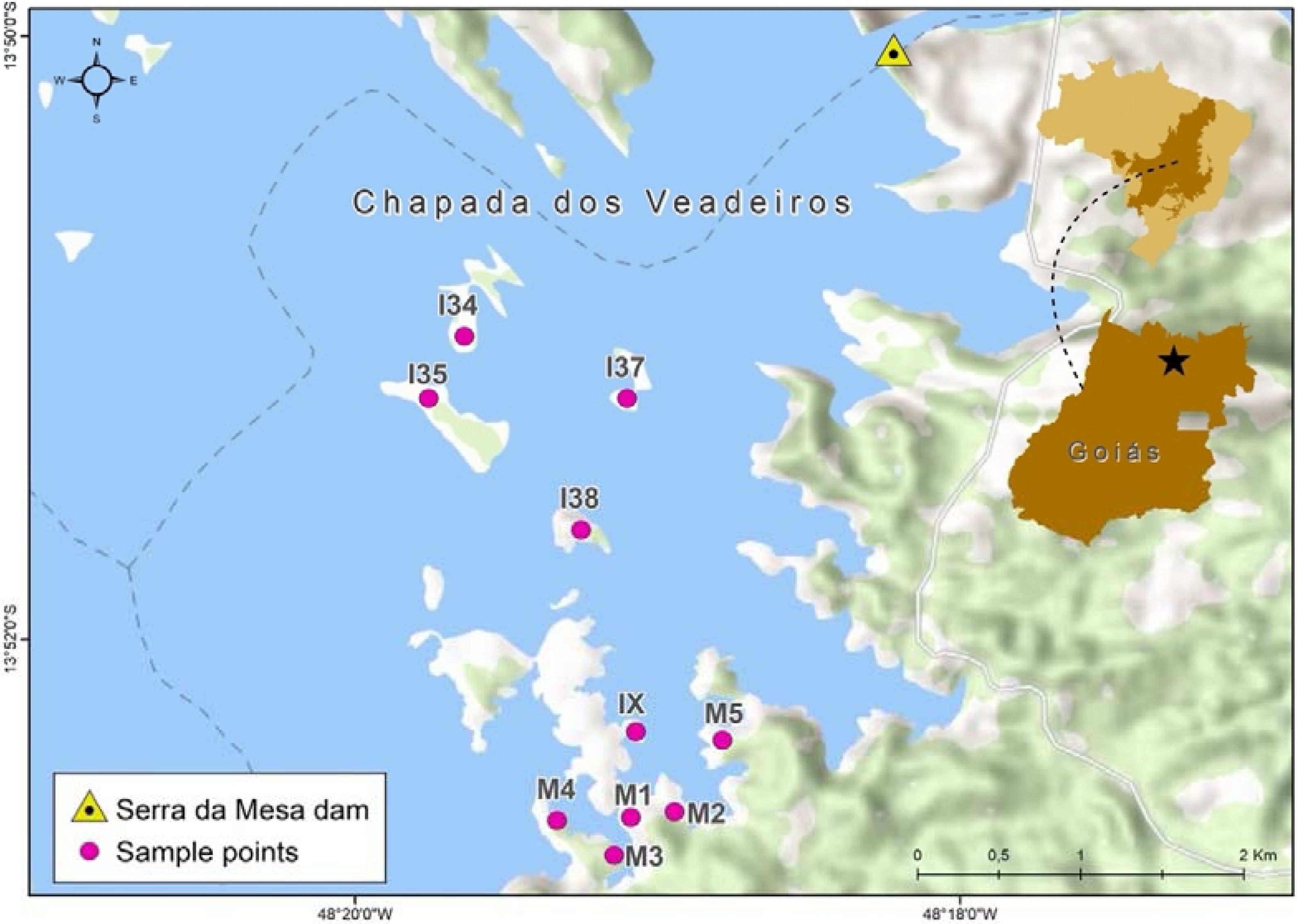
Material and MethodsStudy areaThe Serra da Mesa dam, located in Goiás, central Brazil (48º 20’W; 13º 51’S), in the Cerrado biome, created a 178 km² lake by damming the Tocantins River. This flooding, from 1996 to 1999, isolated 280 hilltops as islands, 80% of which were under 3 ha and some exceeding 1000 ha. Eight hilltops (predicted to be future islands) were selected for pre-flood monitoring, and after flooding, five islands (I-34, I-35, I-37, I-38, IX; Fig. 1) remained. Selection criteria included vegetation type, disturbance levels, and accessibility. All selected islands were characterized by typical Cerrado sensu stricto vegetation, with similar structural composition (e.g., shrub–tree density and ground cover). Prior to flooding, sites showed low levels of anthropogenic disturbance, with no history of agriculture or recent fire events beyond natural regimes. Accessibility was considered to ensure consistent long-term monitoring, but did not influence ecological characteristics of site selection. Although some variation in island size and isolation exists (see Table S1), the selected sites were broadly comparable in habitat structure and initial community composition before flooding. Mainland sites (M1– M5; Fig. 1) were also monitored for comparison. The same hilltop sites monitored before flooding became our island sites following reservoir formation, while mainland sites (within continuous habitat) were sampled throughout the study period and were used for temporal comparisons. The number and identity of sites sampled before and after flooding are detailed in Table S4. Because of temporal changes in reservoir water level, some hilltops, initially expected to become islands, actually became peninsulas, whereas some mainland sites were only sampled after lake formation in 2001 and subsequent years. As a result, site-level comparisons across all sampling periods are not directly possible, and data are presented at the site-type or pooled level to ensure comparability and avoid misleading interpretations. Island IX later reconnected to the mainland due to fluctuating water levels.
Species survey and monitoringLizard richness, abundance, and species presence were assessed through visual surveys, pitfall trapping, and controlled burns. Visual surveys were conducted from July to October 1996, followed by bimonthly pitfall trapping until January 1999, using 315 traps across 21 grids (72 m² each), left open for 13 days monthly. Lizards were measured, toe-clipped for marking, and released at the same place where they were captured. Although individuals were marked during early sampling, no mark–recapture models were applied due to low recapture rates, and abundance estimates are based on raw counts interpreted as indices of relative abundance, as differences in detectability among species and across sampling methods were not explicitly modeled.
In 2001, 2011, and 2019, rocky soils, island slopes' steepness, and reduced sample areas required switching to fire-square sampling. From 2001 to 2019, every survey included all mainland and island sites (once they were formed). Ten 50 m x 50 m plots, enclosed with plastic fences, were cleared using controlled burns, exposing lizard shelters. Because this method involves the collection and removal of individuals, it may influence local abundance estimates, particularly for rare species. While rarefaction analyses were used to assess differences in sampling effort (Velho 2010), we acknowledge that pitfall trapping and fire-square sampling also differ in their detection probabilities, which rarefaction cannot account for. However, all applied methods are widely used in herpetofauna sampling and are effective for relative richness sampling. To minimize bias in interpretation, our analyses focus on broad patterns of species presence/absence and community composition across time, rather than direct comparisons of absolute abundance between sampling methods. Importantly, the major patterns reported—such as the loss of large-bodied species and the persistence and dominance of smaller species—were consistent across sampling periods and are unlikely to be driven solely by methodological differences. Similar approaches have been used in previous long-term studies in this system (e.g., Amorim et al., 2017).
Active searches in the squares continued until no lizards were found for two hours. Lizards were measured and weighed, euthanized with lidocaine, preserved, and deposited in the Coleção Herpetológica da Universidade de Brasília (CHUNB). This method ensured no injuries to the specimens and improved the effectiveness of capture. It is important to emphasize that declines of several large-bodied species were already evident before the shift in sampling methodology (Fig. 2), indicating that these trends are unlikely to be driven by differences in sampling approach.
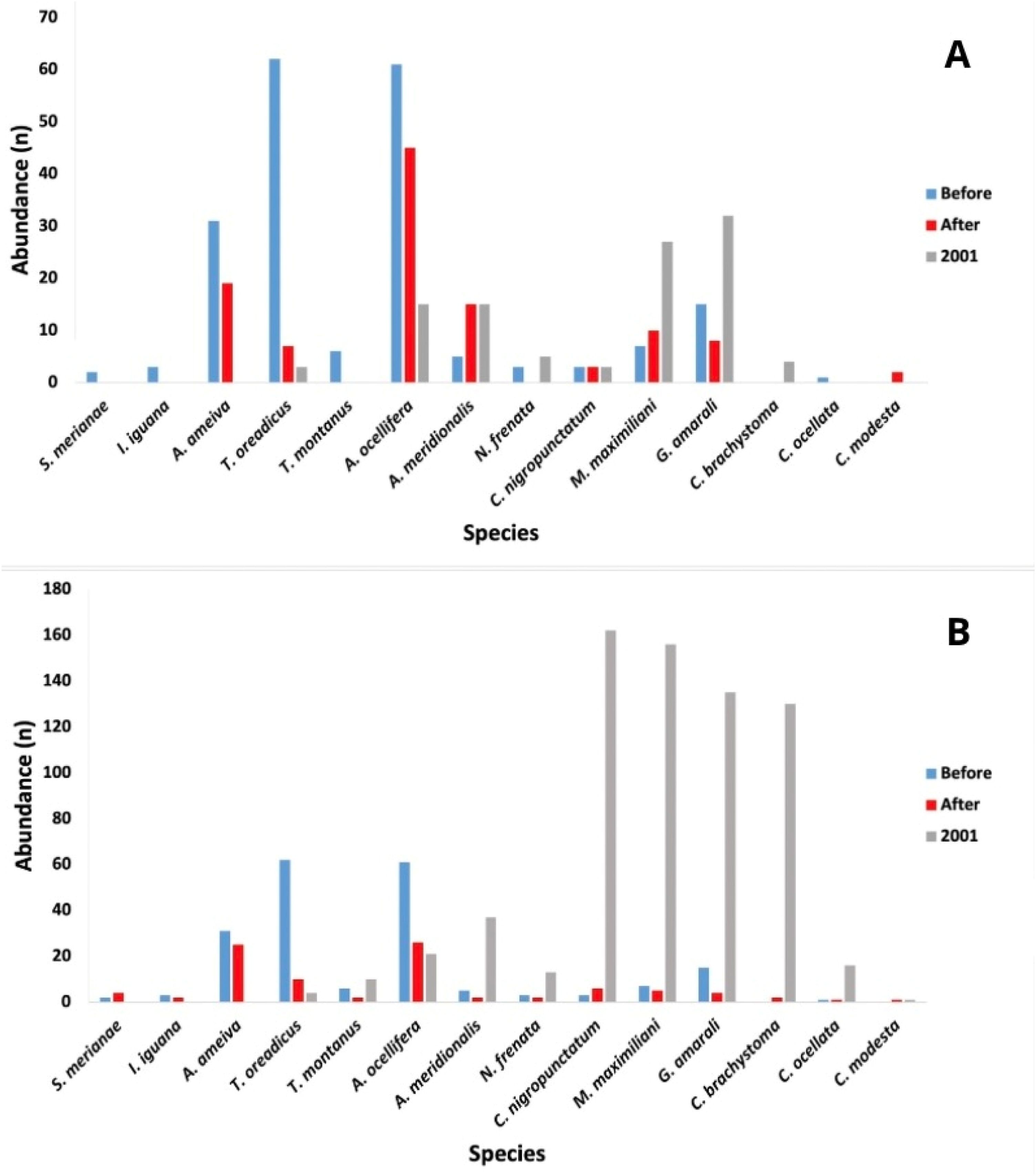
Abundance of lizard species at Serra da Mesa, comparing the first 12 months (1996-1997, before the flooding), the last 12 months (1998-1999, after the flooding), and the 2001 sampling. (A) Mainland sites; (B) Island sites. Abundance is the number of individuals (n). The data include species observed during the transition from hilltops to islands and after reservoir formation. Species are arranged along the x-axis in approximate size order, from larger to smaller.
We measured snout-vent length (SVL) and mass for most lizards during the surveys, but missing data were supplemented using Meiri (2004) (Table S2). While combining field and literature data is not ideal, it was necessary due to gaps in both sources, especially for common species with limited natural history data. By integrating these datasets, we compiled a reasonably complete morphological dataset. Hoplocercus spinosus and Tropidurus torquatus were recorded only during the pre-flood period and were not detected after island formation. Both are associated with more forested habitats, which were largely lost following reservoir filling. Because our analyses focus on persistence and loss dynamics during and after the flooding, these species were excluded from trait-based models. Including species present only in the pre-flood period would effectively assign them identical, immediate extinction times, thereby providing no variation for trait-based inference.
Statistical analysesPatterns of species diversity loss during floodingWe calculated richness, relative abundance, and beta diversity from 1996 to 1999 to describe temporal changes in species composition during the flooding process. Mark-recapture and visual survey data were used to document species presence and relative abundance during the pre-flood and flooding phases. These data were not used to estimate demographic parameters such as survival or detection probabilities, as the sampling design and temporal structure of the dataset do not support robust mark-recapture modeling. Consequently, our analyses focus on community-level patterns of species persistence and changes in species composition, rather than demographic processes. Beta diversity was quantified using Whittaker’s βW index (γ/α − 1), where γ is the pooled species richness, and α is the mean richness across sites (Whittaker 1972; Tuomisto 2010). Values near 1 indicate greater beta diversity (compositional dissimilarity) among sites. Because beta diversity is calculated from pairwise comparisons among sites, these values are not statistically independent and are interpreted descriptively rather than as independent replicates. These comparisons quantify spatial variation in species composition among sites within each sampling period and do not directly measure within-site temporal turnover based on consistent tracking of individual sites through time.
Differences in beta diversity, richness, and relative abundance across sampling periods were summarized descriptively to characterize temporal variation in the hilltop assemblages before flooding and the island assemblages after inundation. A simple linear regression was used descriptively to summarize overall temporal trends in species abundance during the flooding period (1996–1999). Because these regressions do not account for temporal autocorrelation, they were used to describe general patterns rather than for formal statistical inference. Although both island and mainland sites were monitored each sampling year, the diversity calculations presented here focus on island sites to describe temporal dynamics during flooding. Formal comparisons between island and mainland dynamics are addressed in subsequent analyses. This decision was driven by our interest in understanding changes in species composition in isolated environments. In further analyses described below, we directly compare rates and patterns of species loss between island and mainland sites across the whole sampling period.
Because these analyses do not include mainland sites as a contemporaneous control, they should be interpreted as descriptive of temporal dynamics within islands rather than as tests of insularization effects. Additionally, we accounted for repeated measurements through time by including site as a random effect and modeling temporal structure where appropriate, thereby avoiding the treatment of subsamples or repeated observations as independent replicates. We also note that the number of independent spatial replicates in this study is limited, which constrains statistical power and the complexity of models that can be reliably fitted. Accordingly, our inference is primarily supported by temporal replication and consistent ecological patterns rather than large sample sizes across independent sites.
Differences in community-level species persistence between islands and the mainlandWe constructed a generalized linear mixed-effects model to assess whether lizard species richness declined differently on the islands than in the mainland sites from 1996 to 2019. The response variable was the proportion of species at each site from a pool of 17 species (excluding Hoplocercus spinosus and Tropidurus torquatus). Fixed effects included site type (island or mainland), years post-flooding, and their interaction. The model used a binomial error distribution with a logit link and a random intercept of site. We fit the model using the glmmTMB function from the {glmmTMB} library (Brooks et al. 2017). We initially tested the significance of the fixed effects using type III analysis of deviance, implemented by the ANOVA function in the {car} R library (Fox & Weisberg, 2019). In the absence of significant interactions, we instead used type II analysis. We used the {DHARMa} library (Hartig 2024) to perform model diagnostics, including using the testTemporalAutocorrelation function (to fit a residuals-by-time plot and a Durbin-Watson test) to check for the presence of temporal autocorrelation in the model residuals. There was no evidence of temporal autocorrelation in the plotted residuals or Durbin-Watson test (DW = 1.78, p = 0.796).
Effects of island size and isolation on species persistenceWe constructed a generalized linear mixed-effects model to evaluate how island size and isolation (distance from the nearest island or mainland) influenced lizard species richness post flooding, from 1996 to 2019. The response variable was the proportion of lizard species on each island at each census point. Fixed effects included Box-Cox-transformed island size (lambda = 0) to correct for skew, distance, census year, and the interactions of year with size and year with distance. We again used a binomial error distribution and a random effect of site. We fit the model using the glmmTMB function in the eponymous library and tested the significance of the fixed effects using type III analysis of deviance, implemented by the ANOVA function in the {car} R library. In the absence of significant interactions, we instead used type II analysis. We again used the {DHARMa} library to perform model diagnostics and to check for the presence of temporal autocorrelation. There was no evidence of temporal autocorrelation in the plotted residuals or Durbin-Watson test (DW = 1.174, p = 0.267).
Body size and patterns of species persistenceLastly, we used mixed-effect Cox proportional hazards models to assess whether larger lizard species faced greater risks of being lost from island and mainland sites over time since reservoir construction. Due to violations of proportional hazards assumptions, separate models were run for island and mainland sites. Body mass (g) and SVL (mm) were analyzed separately due to high correlation (r = 0.96) and log-transformed to account for size variability. The response variable was species retention or loss (0 or 1) at each site and census point. Random intercepts accounted for site and phylogenetic relatedness (species nested within genus and family). We fit these models with the coxme function from the eponymous library (Therneau, 2022) and tested the significance of the fixed effects using type II analysis of deviance, implemented by the ANOVA function in the {car} library.
All statistical analyses were conducted in R 4.2.3 (R Development Core Team, 2023), except for the comparisons of beta diversity, richness, and abundance, which were performed using SYSTAT 7.0 and SAS. Species represented by very few individuals were included in trait-based analyses, but results for these species should be interpreted with caution due to limited sample size.
ResultsPatterns of species diversity loss during floodingWe recorded 19 lizard species in the sampled area before and during the flooding, distributed among 10 families: Teiidae (4 species), Gymnophtalmidae (3), Tropiduridae (3), Anolidae (2), Scincidae (2), Hoplocercidae (1), Iguanidae (1), Phyllodactylidae (1), Polychrotidae (1), and Sphaerodactylidae (1) (Table S3). These included 15 species at hilltops and 17 in valleys that were later flooded, with two species (Tropidurus montanus and Anolis meridionalis) found only at hilltops. Four species (Tupinambis quadrilineatus, Tropidurus torquatus, Hoplocercus spinosus, and Polychrus acutirostris) were initially observed in valley habitats but later appeared on hilltop islands. Seven species were Cerrado endemics, and the early saurofauna primarily consisted of heliophile and habitat-generalist species. These patterns were evident from the magnitude and consistency of changes in species abundance and composition across sampling periods.
Beta diversity was calculated for all pairs of hilltop (future-island) sites before flooding, all island pairs after flooding, and between pre- and post-flooding assemblages of hilltop (future-island) and island sites. Mean beta diversity increased from 0.434 ± 0.148 before flooding (1996) to 0.524 ± 0.181 after flooding (1999), indicating greater compositional dissimilarity among sites following flooding. Because pairwise beta-diversity values are not statistically independent, these values are presented as descriptive summaries rather than formal statistical tests. Accordingly, the observed difference in beta diversity should not be interpreted as unequivocal evidence of an effect of insularization.
Between 1996 and 1999, 485 lizards from 13 species were captured using pitfall traps. Several large-bodied species, including Ameiva ameiva, Ameivula ocellifera, Tropidurus oreadicus, and T. montanus, exhibited consistent declines in abundance during the flooding period (Fig. S1). Simple linear regressions were used descriptively to summarize these temporal trends and were not used for formal statistical inference. The large A. ameiva was last recorded in 1998 and was not detected in the following island samples.
Ameiva ameiva, Ameivula ocellifera, and Tropidurus oreadicus were the most abundant lizards at hilltops before flooding, and Tropidurus montanus was also common during this period as one of the larger non-teiid species in the assemblage. Abundance declines of A. ameiva and T. oreadicus were also observed at mainland sites during reservoir formation (Pavan 2001). The remaining nine lizard species are smaller, more secretive, and rarer, with more restricted geographic distribution in some cases. Interestingly, these species did not show a significant drop in abundance during island formation (Fig. 2b).
Nearly all species reported showed declines in abundance at the end of reservoir filling, including the nine smaller species. However, these smaller species exhibited an impressive recovery by 2001 at the island sites (Fig. 2). In 2001, 686 lizards from 12 species were recorded on the islands, six times the 109 lizards on the mainland. Four small species dominated island communities: Copeoglossum nigropunctatum (23.6%), Micrablepharus maximiliani (22.75%), Gymnodactylus amarali (19.68%), and Coleodactylus brachystoma (18.95%), together comprising 73.33% of all individuals. In contrast, larger, once-dominant species (A. ameiva, A. ocellifera, and T. oreadicus) were rare or locally extinct by 2001, with A. ameiva (locally extinct), T. oreadicus (0.6%), and A. ocellifera at just 3%. Large-bodied species like Salvator merianae and Iguana iguana were also not recorded post-flooding (Table S4).
In 2011, we recorded 284 lizards from 12 species across eight families (Anolidae, Gymnophtalmidae, Phyllodactylidae, Polychrotidae, Sphareodactylidae, Scincidae, Teiidae, and Tropiduridae). Of these, 160 specimens were from the mainland and 124 from eight species on the islands. Gymnodactylus amarali dominated the islands, accounting for 44.6% of individuals. Polychrus acutirostris was exclusive to the islands, while Anolis brasiliensis, A. meridionalis, Tropidurus montanus, and Salvator merianae were restricted to the mainland.
By 2019, we had recorded only 24 individuals across six species. The islands had 15 lizards from five species, with G. amarali still dominant (40%). Colobosaura modesta was observed exclusively on the mainland.
Differences in community-level species persistence between islands and the mainlandThe proportion of lizard species out of the total pre-flood species pool fell across the duration of the study, averaged over the mainland and island sites (slope [95% CI] = -0.081 [-0.101 – -0.062], χ2 = 64.3, p < 0.0001). The rate of local species extinction was similar across island and mainland sites (island slope: -0.097 [-0.126 – -0.069]; mainland slope: -0.065 [-0.92 – -0.038], χ2 = 2.53, p = 0.111) with overlap between the 95% confidence intervals of the estimated slopes (Fig. 3). The mean proportion of species was also similar between the island and mainland sites, estimated at the midpoint of our sampling period (mean proportion [95% CI] = island: 0.378 [0.323 – 0.436]; mainland: 0.337 [0.286 – 0.392]).
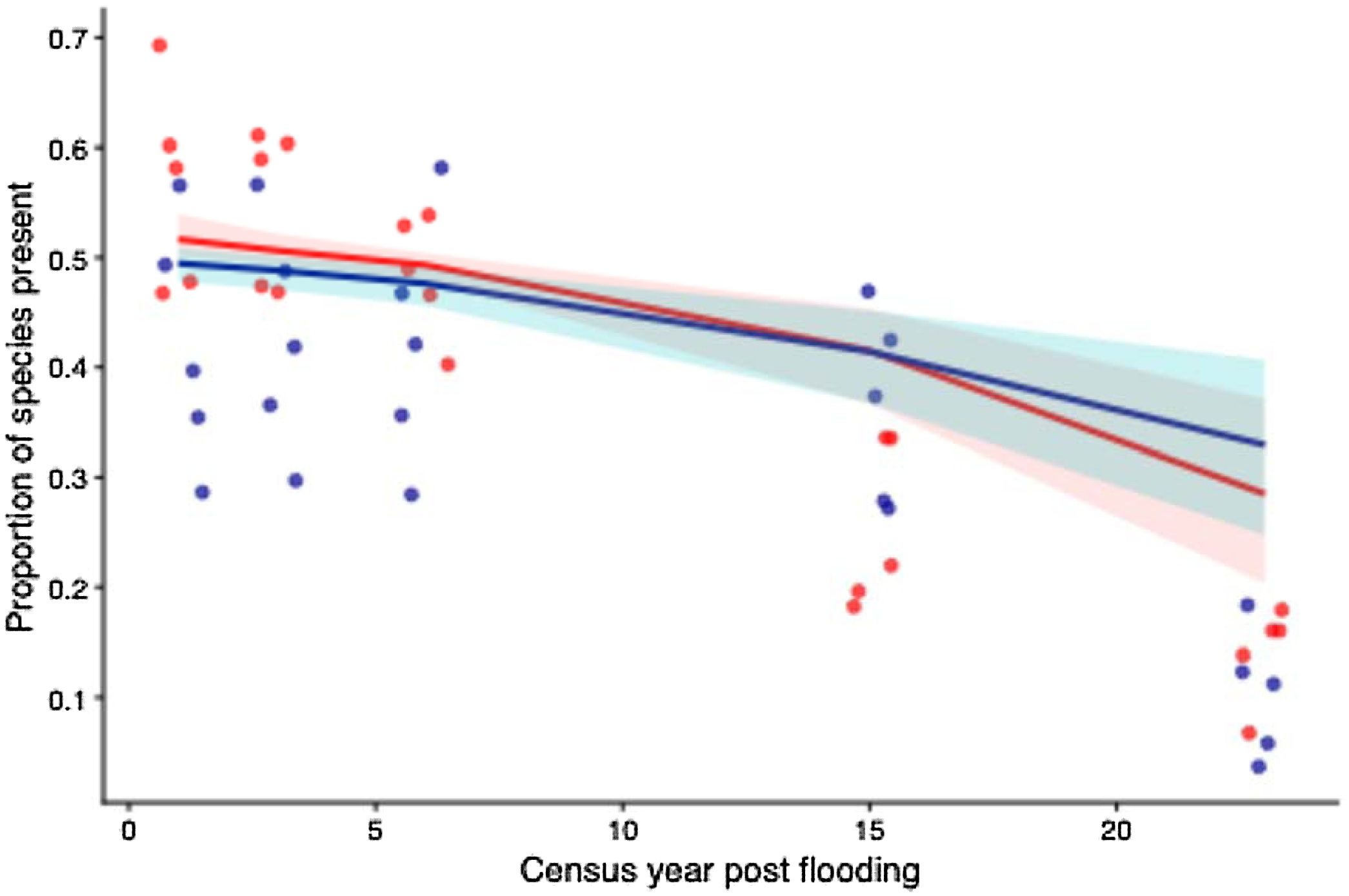
Change in species richness on the island and mainland sites over time post flooding predicted from a generalized mixed model. The predicted relationship for island and mainland sites is shown by the red and blue curves, respectively, with shaded 95% confidence intervals. Island (red) and mainland (blue) data points are jittered horizontally.
As seen in the island-mainland comparison, the proportion of lizard species out of the total pre-flood species pool fell across the duration of the study on island sites (slope [95%CI] = (-0.097 [--0.127 -0.069], χ2 = 43.4, p <0.0001). However, there was no evidence that island isolation (estimate [95% CI] = -0.177 [-1.81 – 1.45], χ2 = 0.092, p = 0.761) or the interaction between island isolation and year influenced lizard species loss (estimate [95% CI] = 0.044 [-0.109 – 0.198], χ2 = 0.33, p = 0.565). Likewise, there was no evidence that island size (estimate [95% CI] = 0.161 [-0.109 – 0.432], χ2 = 0.320, p = 0.571) or an interaction between island size and census year influenced species loss (estimate [95% CI] = -0.014 [-0.039 – 0.011], χ2 = 1.14, p = 0.286), with confidence intervals spanning zero for these estimated effects.
Body size and patterns of species persistenceWe found that larger lizard species had higher risks of being lost from island sites. This was true for both measures of size (Fig. 4A-B). Specifically, there was a 77% increase in risk for a 10% increase in SVL (hazard ratio [95%CI] = 1.77 [1.24 – 2.29], χ2 = 4.56, p = 0.0327) and a 20% increase in risk for a 10% increase in mass (1.20 [1.03 – 1.36], χ2 = 4.898, p = 0.0269). In contrast, the risk of species loss associated with greater SVL and mass was smaller on mainland sites with an increase in 11% and 3% risk for a 10% increase in SVL and mass respectively (ln SVL: 1.11 [0.975 – 1.24], χ2 = 2.15, p = 0.143; ln mass: 1.03 [0.987 – 1.072], χ2 = 2.19, p = 0.139), Fig. 4C, D).
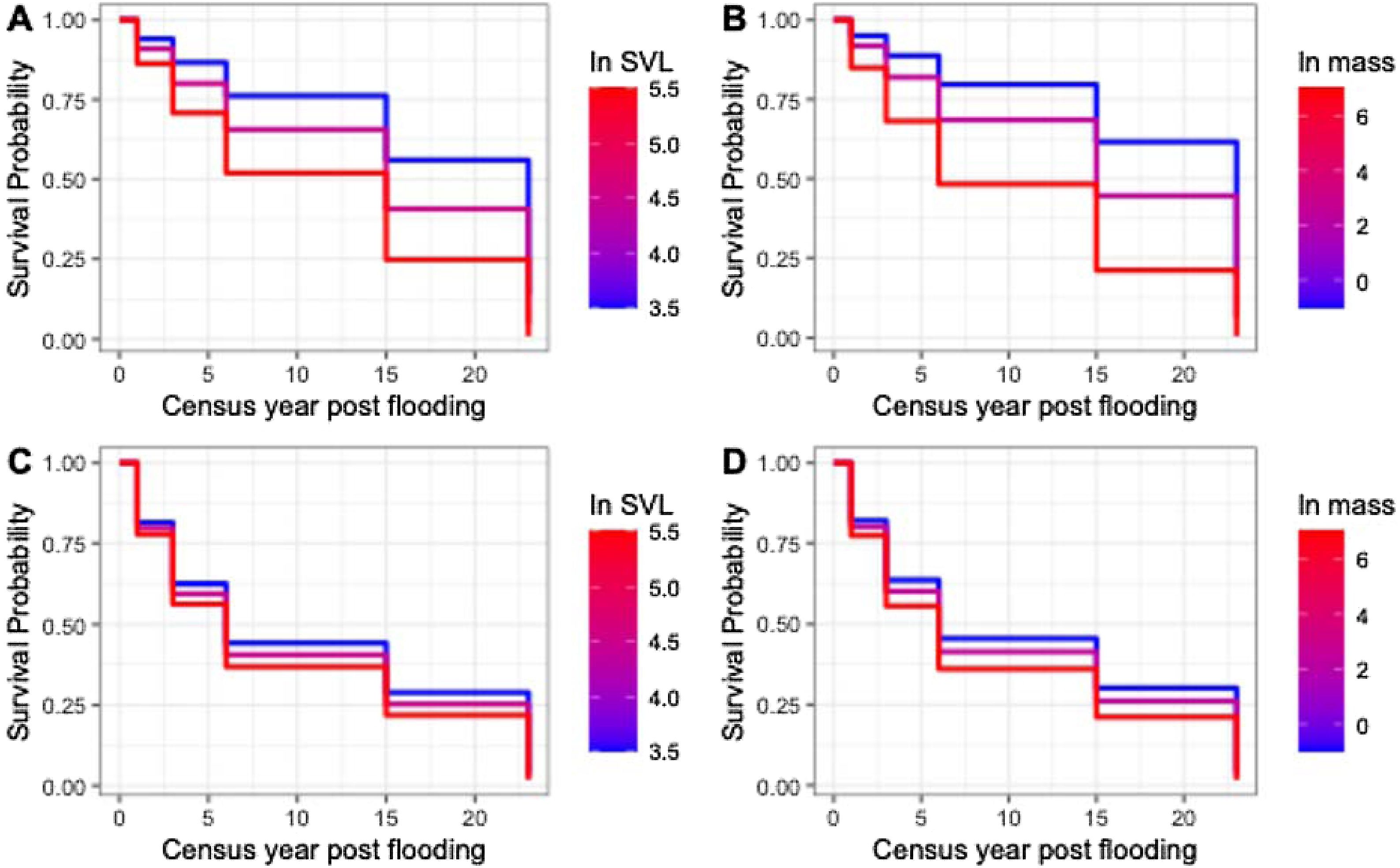
Survival probabilities across the post-flooding census years for island (A, B) and mainland (C, D) lizard species in relation to mean species body size. As there are currently no existing methods to visualize survival curves from mixed-effect Cox proportional hazards models, the depicted survival curves are from models without the random effects of site or taxonomy fit using the coxph function in the {survival} library (Therneau 2024). Consequently, these survival curves should be interpreted only as representative of the mixed-effects Cox models.
The results are consistent with our hypothesis that habitat fragmentation effects affect lizard species in different ways, with larger, more common species being more vulnerable to insularization in Serra da Mesa. While some analyses describe temporal dynamics within island sites, our inference about insularization effects relies on explicit comparisons to mainland sites. The decline in lizard abundance and species richness from 1996 to 2019 was severe, with the community shrinking from 19 species across 10 families to 6 species across five families. Common, larger, diurnal, habitat-generalist lizards disappeared from islands, while rarer, smaller, more habitat-specialist species became dominant. Contrary to expectations of reduced beta diversity among islands due to species loss, beta diversity increased, reflecting idiosyncratic shifts in species composition during flooding. This may be due to species migrating from valleys to higher ground as water levels rose, though this contribution to beta diversity trends was not directly assessed. While this pattern in species loss is consistent with deterministic processes following flooding, we acknowledge that stochastic species loss would also tend to increase beta diversity (Püttker et al. 2015). Thus, we cannot rule out the possibility that some of the observed patterns of beta diversity may reflect random species loss. However, lizard communities on the islands were similar in the last surveys, suggesting that species that migrate from valleys were not successful in island colonization. The strength of these patterns is evident from their magnitude and consistency across sampling periods.
Our analyses combine long-term monitoring with multiple sampling approaches, and we acknowledge that methodological differences across sampling periods may influence detectability and abundance estimates. In addition, voucher collection during later surveys may have affected local counts, particularly for rare species. On the other hand, our analyses are based on relative abundance and do not explicitly account for detectability, and because some species were represented by few individuals, our results should be interpreted as reflecting broad community-level patterns rather than precise demographic estimates. In particular, apparent losses of species represented by very few individuals should be interpreted with caution, as they may reflect detection or sampling effects rather than true disappearance. However, several key patterns—such as the early and sustained decline of large-bodied species before the methodological changes (Fig. 2) and the consistent differences observed between island and mainland sites—suggest that the main findings are unlikely to be driven solely by methodological factors. In light of these limitations, it is particularly important that our conclusions, while supported by statistical analyses, are based on consistent qualitative patterns rather than strict quantitative comparisons across sampling methods.
Gainsbury & Colli (2003) attributed extinctions in Amazonian Cerrado enclaves to stochastic historical factors, while other studies suggest generalist and abundant species persist better after habitat fragmentation (e.g., Smith et al. 1996; Palmeirim et al. 2017, 2021). Opposite to these findings, our results highlight the persistence of smaller, specialist, and initially rarer lizards. Species that declined during the Serra da Mesa flooding are still common in Cerrado remnants near Brasília (Colli 1991; Colli et al. 2002), indicating unique community (dis)assembly processes in Serra da Mesa compared to other fragmentation events. Species loss thus appears context-dependent, influenced by fragmentation type, species’ requirements, or site history.
Fragment size, connectivity, and distance have previously been shown to influence lizard richness (Smith et al. 1996), aligning with the Theory of Island Biogeography (MacArthur and Wilson 1967). In contrast, our study found no effect of distance and no significant difference in the proportion of species present between islands and mainland sites. Larger islands initially had more species but experienced sharper declines, whereas smaller islands recovered by 2001. It is possible that a general reduction in food and spatial resources during the islands’ formation could have favored smaller species with lower energy demands (e.g., lower daily food intake) and, in turn, conferred an advantage in poorer habitats (Kemp & Hadly 2015). Similarly, gekkonid and scincid lizards are the most common on ocean islands (Carlquist 1965). Thus, our study reveals that in the Serra da Mesa community, the smaller, more secretive, and rarer species have a survival advantage over the larger, generalist, and more conspicuous lizards. These results suggest a directional selection event in the lizard community following flooding of the Serra da Mesa reservoir.
During the flooding, birds of prey, such as eagles, hawks, and falcons (Accipitridae, Falconidae), were frequently observed on the islands, and several predation events were recorded throughout the fieldwork. Some bird species considered important reptile predators, such as the red-legged seriema (Cariama cristata) and the guira cuckoo (Guira guira) (Redford and Peters 1986; Souza et al. 2022), became very common on the islands during the flooding process. Raptors, as diurnal, visually oriented hunters (Jaksić 1983), likely targeted larger, diurnal lizards such as A. ameiva, A. ocellifera, and Tropidurus spp., making them more vulnerable than smaller, nocturnal or secretive species such as C. brachystoma, G. amarali, M. maximiliani, and mabuids. These “hidden lizards” rely on retreat sites such as termite and ant mounds or debris (Colli et al. 2002). This suggests predation, in addition to higher energy demands, may have contributed to the biased loss of larger species.
In conclusion, our results are consistent with the expectation that body size and habitat loss contribute to the observed decline in lizard diversity in the Serra da Mesa system. Our findings suggest that fragmentation, morphology (larger body size), and possible ecological (e.g., predation) and physiological (e.g., lower energetic requirements) factors likely contributed to the post-flood community structure in land-bridge islands. Although hydroelectric dams are often considered a clean energy source, they can lead to fragmentation, degradation, and habitat impoverishment (Jones et al. 2016; Palmeirim et al. 2018). Maintaining larger continuous areas of native vegetation during reservoir planning and implementation is therefore critical. Rather than representing long-term conservation units, land-bridge islands provide insight into the ecological consequences of fragmentation and the processes driving species persistence and loss in altered landscapes.
Data AvailabilityThe data that support the findings of this study are openly available in Figshare at https://figshare.com/articles/dataset/Serra_da_Mesa_Lizards/33797062, reference number 10.6084/m9.figshare.33797062.
Declaration of Interest StatementThe authors declare that they have no known competing financial interests or personal relationships that could have appeared to influence the work reported in this paper.
We thank Maria Eduarda Coelho for the help with the map. This work was funded by PPG-Zoo and the Presidential Society of STEM Postdoctoral Fellows program at Case Western Reserve University to RBM, and Centro UnB-Cerrado to RAB and RBM. RAB also thanks CNPq (Conselho Nacional de Desenvolvimento Científico e Tecnológico) for his research fellowships and financial support (processes #306644/2023-7, #306994/2023-2, and #401334/2025-2).
The following is Supplementary data to this article: